Why Deadline Tracking Is the Most Important Feature in Any Immigration Software
Ask any immigration attorney what keeps them up at night and the answer is almost always some version of the same thing: a deadline that gets missed. Not a deadline they forgot about. A deadline that slipped through a system that was supposed to catch it.
A missed H-1B cap filing means a full year before the next lottery. A missed RFE response deadline means case denial. A missed green card priority date window can add years to a beneficiary's wait. In immigration law, the consequences of a missed deadline are not recoverable. There is no filing an amended return. There is no asking for an extension. When the window closes, it closes.
This is why deadline tracking is not just a feature in immigration practice management software. It is the feature everything else depends on. A platform that drafts documents beautifully, manages billing seamlessly, and communicates with clients perfectly, but fails to surface a critical USCIS deadline before it passes, has failed at the most important job it has.
Yet deadline tracking is also one of the most inconsistently implemented features in the immigration software market. Most platforms have it. Very few have it in a way that actually prevents the scenario described above.
The Difference Between Passive and Active Deadline Tracking
This distinction is at the heart of why deadline tracking varies so dramatically in practice across different platforms.
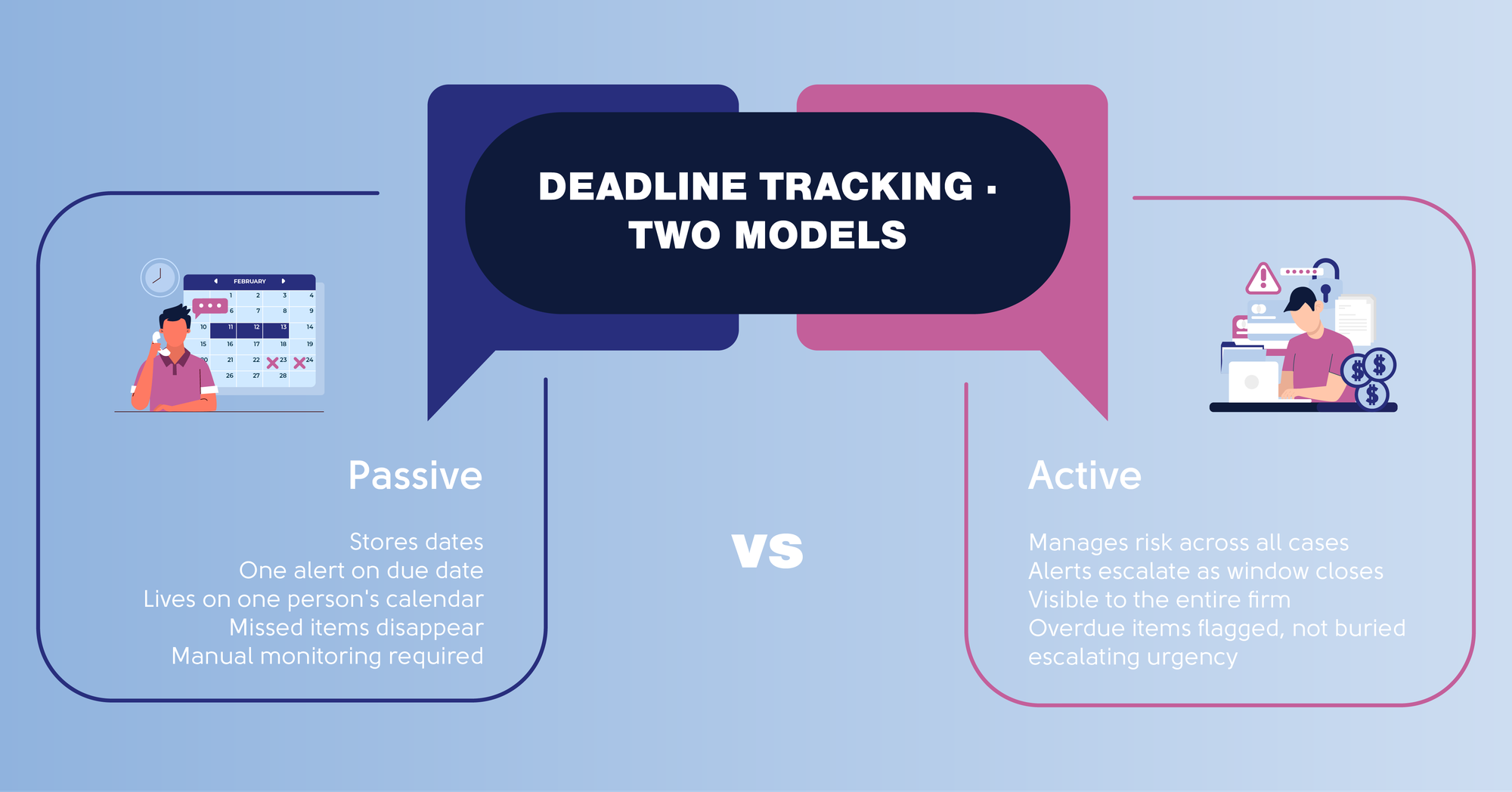
Passive deadline tracking stores dates. It gives you a place to record when things are due. It may send a reminder on the deadline date or a day before. It may show you a calendar view of upcoming dates. What it does not do is actively manage the risk that a deadline represents.
Passive tracking assumes that someone in the firm is monitoring the system, checking the calendar, and taking action when something appears. It assumes that the person who entered the deadline will still be there when it comes due, that they will see the reminder, and that they will have the capacity to act on it in time. In a high-volume practice, every one of those assumptions can fail.
Active deadline tracking manages the deadline rather than just recording it. It surfaces upcoming deadlines across the entire caseload automatically, without anyone having to go looking. It assigns ownership to each open action so there is never ambiguity about whose responsibility it is to move something forward. It escalates as windows close, with increasing urgency as the deadline approaches. And it operates at the firm level, not the individual level, so a deadline is never invisible to the practice simply because the person who entered it is out that day.
The difference between those two models is not cosmetic. In a filing season with dozens of active cases and multiple concurrent deadlines, passive tracking is a system that will eventually fail.
Active tracking is a system designed to prevent the failure.
What Active Deadline Management Looks Like in Toorey
Toorey's deadline tracking is built on the active model, with several specific design choices that make it meaningfully different from a calendar with reminders.
Every deadline is case-level, not person-level. When a filing deadline is set on a case in Toorey, it belongs to the case record, not to an individual attorney's calendar. Every authorized team member can see it. If the attorney handling that case is out, the deadline is still visible, still active, and still escalating. Nothing is lost with a person.
Deadlines are tracked across the entire caseload in a single view. At any point, an attorney or firm administrator can pull up a deadline dashboard showing every active case with an upcoming filing window, RFE response deadline, or internal milestone, sorted by proximity. This is not a calendar. It is a risk dashboard. It tells the firm, in one view, where the time-sensitive work is and what the current status of each item is.
Internal milestones are tracked alongside USCIS deadlines. The filing deadline is the hard external constraint, but the chain of preparation steps that has to complete before that deadline is equally important. In Toorey, firms can set internal milestones: when the employer documentation needs to be in, when the first draft needs to be complete, when the attorney review needs to happen. Each of these has its own deadline and owner. The system tracks all of them, surfacing the chain of preparation steps as a managed sequence rather than leaving it to the team to figure out the timing informally.
Alerts escalate as deadlines approach. Toorey does not send a single reminder and consider the job done. Alerts escalate in frequency and urgency as a deadline approaches. An RFE response due in 60 days gets a different level of attention than one due in 14 days. The system reflects that difference automatically rather than treating all upcoming deadlines with the same level of urgency regardless of proximity.
Overdue items are flagged, not buried. If an action that was supposed to happen by a certain date has not happened, Toorey surfaces it as overdue rather than letting it disappear from view. This is one of the most important failure modes in passive tracking systems: a missed internal milestone that should have triggered action simply disappears from the calendar without generating any signal that something went wrong.
The H-1B Season Stress Test
H-1B cap season is the best stress test for any deadline tracking system because it concentrates the maximum number of hard, irrecoverable deadlines into the shortest possible window.
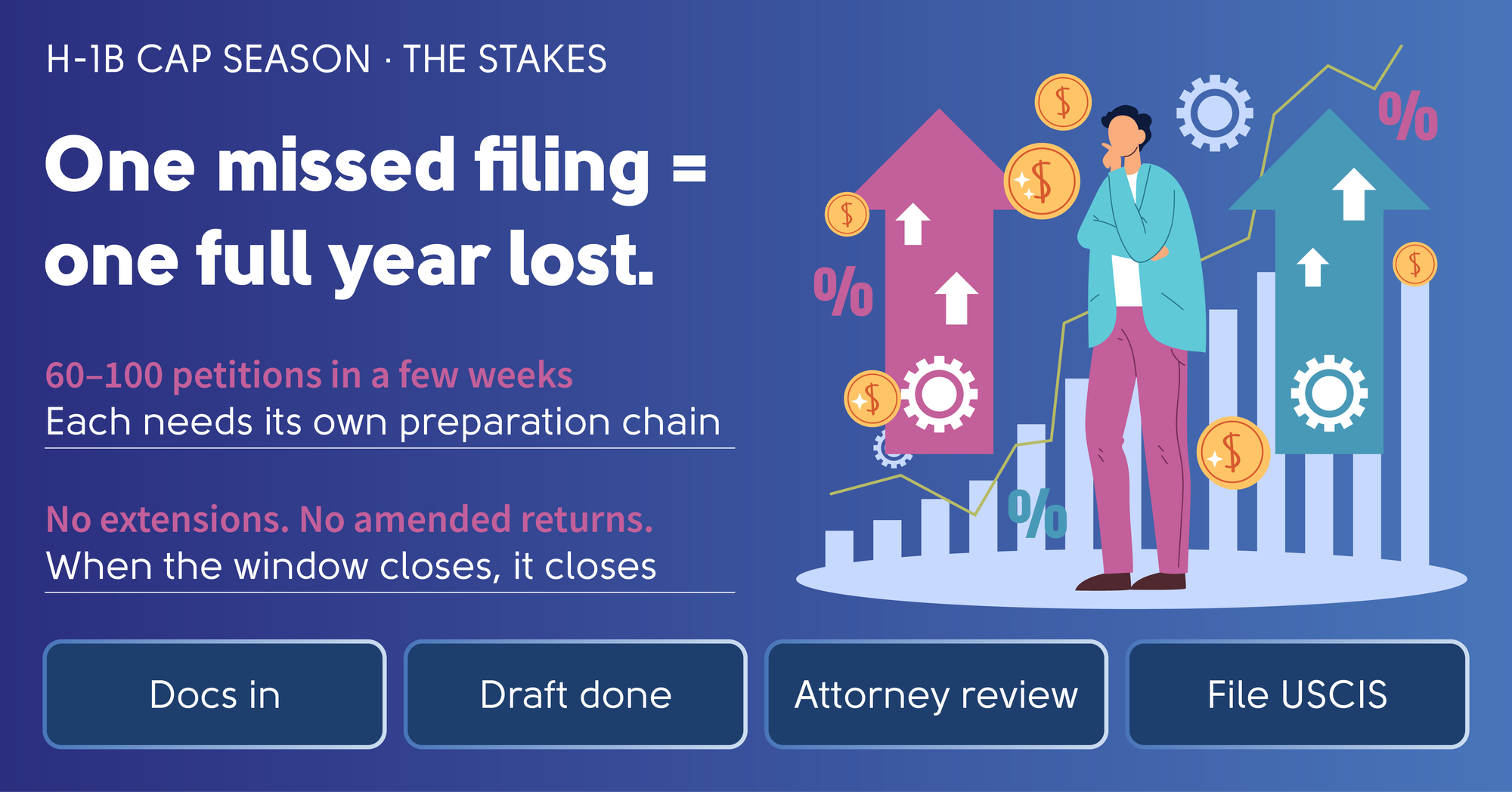
During cap season, a high-volume immigration firm may have 40, 60, or 100 petitions that need to be filed within the same few-week window. Each of those cases has its own chain of preparation steps that have to complete before the filing can go out. Each has employer documentation that needs to arrive by a specific internal date, a drafting step that needs to happen, an attorney review that needs to be completed, and a filing packet that needs to be assembled and shipped.
In a passive tracking system, managing this is a manual coordination exercise. Someone, usually a senior paralegal or the managing attorney, has to actively track the status of every case against every milestone, identify the ones that are at risk, and escalate accordingly. At high volume, this becomes the primary job of at least one person, and it is still prone to things slipping through.
In Toorey's active tracking system, the platform does this work. The deadline dashboard shows every H-1B case, its current preparation status, the next internal milestone, and how much time remains. Cases that are at risk surface automatically. Escalations happen without anyone having to manually monitor and report on case status.
The attorney's job is not to track the deadlines. It is to act on what the system surfaces. That is a fundamentally different and more sustainable way to manage a filing season.
RFE Response Deadlines: Where Missed Deadlines Are Most Common
If H-1B cap season is where volume creates deadline risk, RFE responses are where complexity creates it.
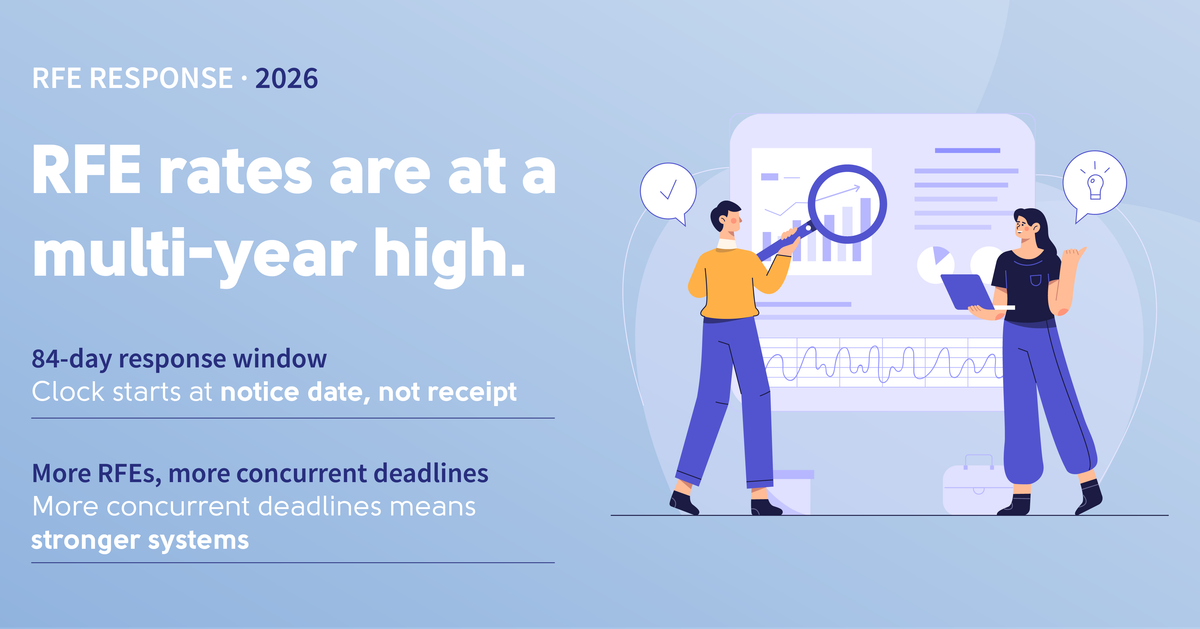
An RFE arrives on a case that is already active in the system. It has a response window, typically 84 days, that begins running from the date on the notice, not the date it was received or opened. If an RFE sits in a mailbox for three days before being logged, the response window is already three days shorter than it appears.
For firms managing RFE volume manually, this is a real and recurring risk. RFEs arrive unpredictably, on cases at different stages of preparation, requiring different levels of attorney involvement. Tracking them informally, through individual attorney calendars or a shared spreadsheet that requires manual updates, creates the conditions for a deadline to be missed when volume is high or when the attorney responsible for a case is away.
In Toorey, an RFE is logged to the case record as soon as it arrives, with the response deadline calculated automatically from the date of the notice. The deadline enters the active tracking system immediately, with alerts that begin escalating based on the response window. The preparation tasks for the response are assigned with their own internal deadlines. Nothing about the RFE response process is invisible or informal.
Why This Matters More in 2026 Than It Did Before
Two things have changed in the current environment that make active deadline management more important than it was even two or three years ago.
The first is RFE volume. As noted throughout this piece, RFE rates under the current USCIS adjudication standards are materially higher than they were in prior years. More RFEs means more concurrent response deadlines. A system that was adequate for managing three or four concurrent RFE deadlines may not be adequate for managing twelve.
The second is enforcement pressure. The current enforcement environment, across I-9 audits, H-1B scrutiny, and general USCIS processing changes, has raised the stakes attached to every deadline. The cost of a missed filing window or a missed response deadline in 2026 is no lower than it was before, and the frequency with which those moments arise has increased.
The firms that have invested in active deadline management infrastructure are better positioned to absorb this increased load without increasing the risk of the failure that matters most: the deadline that passes before anyone acts on it.
Deadline Tracking as the Foundation of Everything Else
Here is the point that gets lost when deadline tracking is treated as one feature among many: it is not one feature among many. It is the foundation on which every other element of immigration practice management rests.
A beautifully drafted H-1B petition that misses the filing window is worthless. A perfectly assembled RFE response that is submitted after the response deadline is a denial. A client portal that keeps clients informed is meaningless if the underlying case is not moving toward its filing date on time.
Every other capability in an immigration practice management platform delivers its value only if the case is being moved forward within the time it has. Deadline management is what ensures that the time is being used rather than lost.
This is why Toorey treats deadline tracking as infrastructure rather than as a feature. It is the system that makes everything else in the platform produce its intended result. And it is why, when evaluating any immigration software, the deadline tracking question is not just one checkbox on a feature list. It is the most important question on the list.
See how Toorey's active deadline management keeps every case on track across your entire caseload. Book a demo at toorey.com.