How Immigration Billing Software Saves Firms From Revenue Leakage
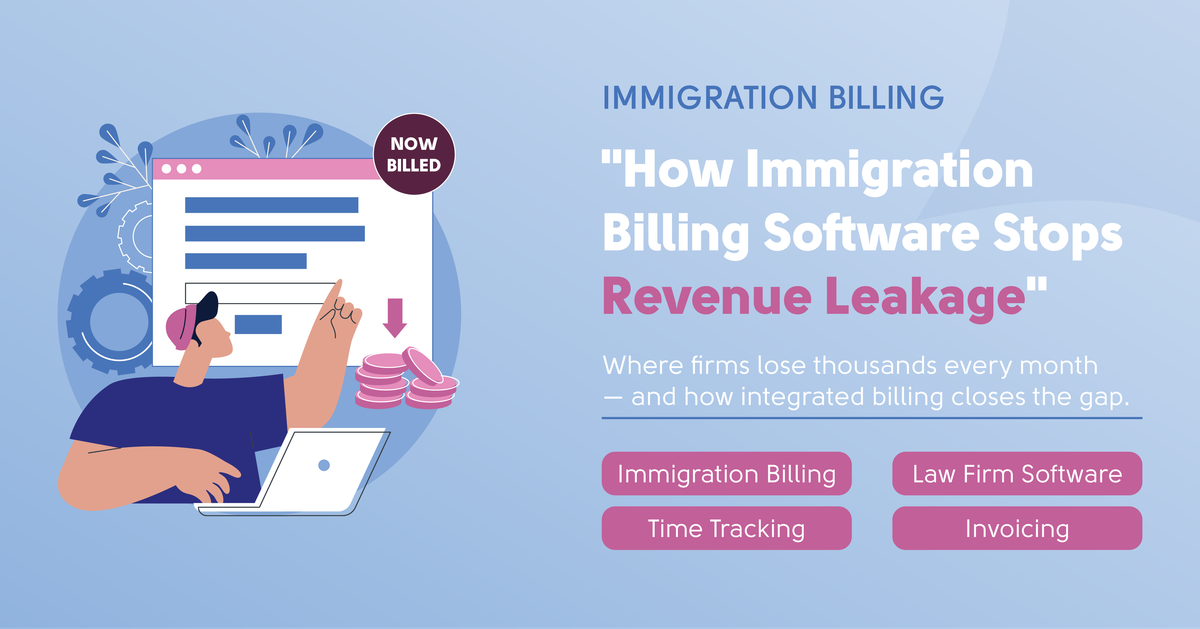
Revenue leakage is one of those problems that feels abstract until you do the math. An immigration attorney who fails to capture two billable hours per day across a 220-day working year has left 440 hours of revenue on the table. At even a modest billing rate, that is a significant sum quietly exiting the practice every twelve months. Not through bad work or client loss. Simply through the gap between work done and work invoiced.
Most immigration firms have this problem. Very few know exactly how bad it is, because the nature of leakage is that it disappears before it can be measured.
This piece breaks down where billing leakage actually happens in immigration practice, why the structure of immigration work makes it particularly prone to under-billing, and how integrated billing software closes the gap in ways that manual processes simply cannot.
Why Immigration Firms Are Especially Prone to Revenue Leakage
Not all legal practice areas have the same billing risk profile. Immigration firms sit at the more vulnerable end of the spectrum for a few structural reasons.
Case work happens in small increments. An immigration case does not unfold in long, continuous work sessions that are easy to track. It unfolds in dozens of small interactions: a ten-minute call with a client to clarify a document, a twenty-minute review of a USCIS notice, a fifteen-minute email exchange with an employer contact, a half-hour spent preparing a cover letter. Each of these is billable. Each requires someone to remember to log it. At high case volume, the ones that do not get logged immediately tend not to get logged at all.
Flat-fee structures obscure the real cost of cases. Many immigration firms price common case types on a flat-fee basis. This is good for client predictability but creates a hidden billing risk: when a flat-fee case generates significantly more work than anticipated, the firm absorbs the excess without compensation. Without time tracking against flat-fee cases, the firm cannot see which case types are consistently over-budget or where the pricing needs to be adjusted. The leakage is structural rather than transactional.
Paralegal time is systematically under-billed. Attorney time tends to be tracked more consistently than paralegal time, partly because attorneys are more accustomed to the billing discipline and partly because attorney billing is the primary revenue focus. Paralegal hours, which represent a substantial portion of the work on any immigration case, are often logged less consistently. At volume, the gap between actual paralegal time and billed paralegal time is significant.
Client disbursements and filing fees fall through the cracks. USCIS filing fees, courier costs, certified mail, and other case expenses are reimbursable in most fee arrangements. When these are not systematically tracked and billed, they simply become costs the firm absorbs. Not large individually. Significant in aggregate.
Billing is disconnected from case activity. This is the root cause that underlies most of the others. When billing lives in a separate system from case management, someone has to manually transfer information from one to the other. That transfer is where things get lost. Time entries that were never made. Expenses that were never logged. Invoices that were prepared from imperfect memory rather than from a complete case record.
Where the Money Actually Goes
To make this concrete, consider what a typical immigration firm loses across a few common leakage points.
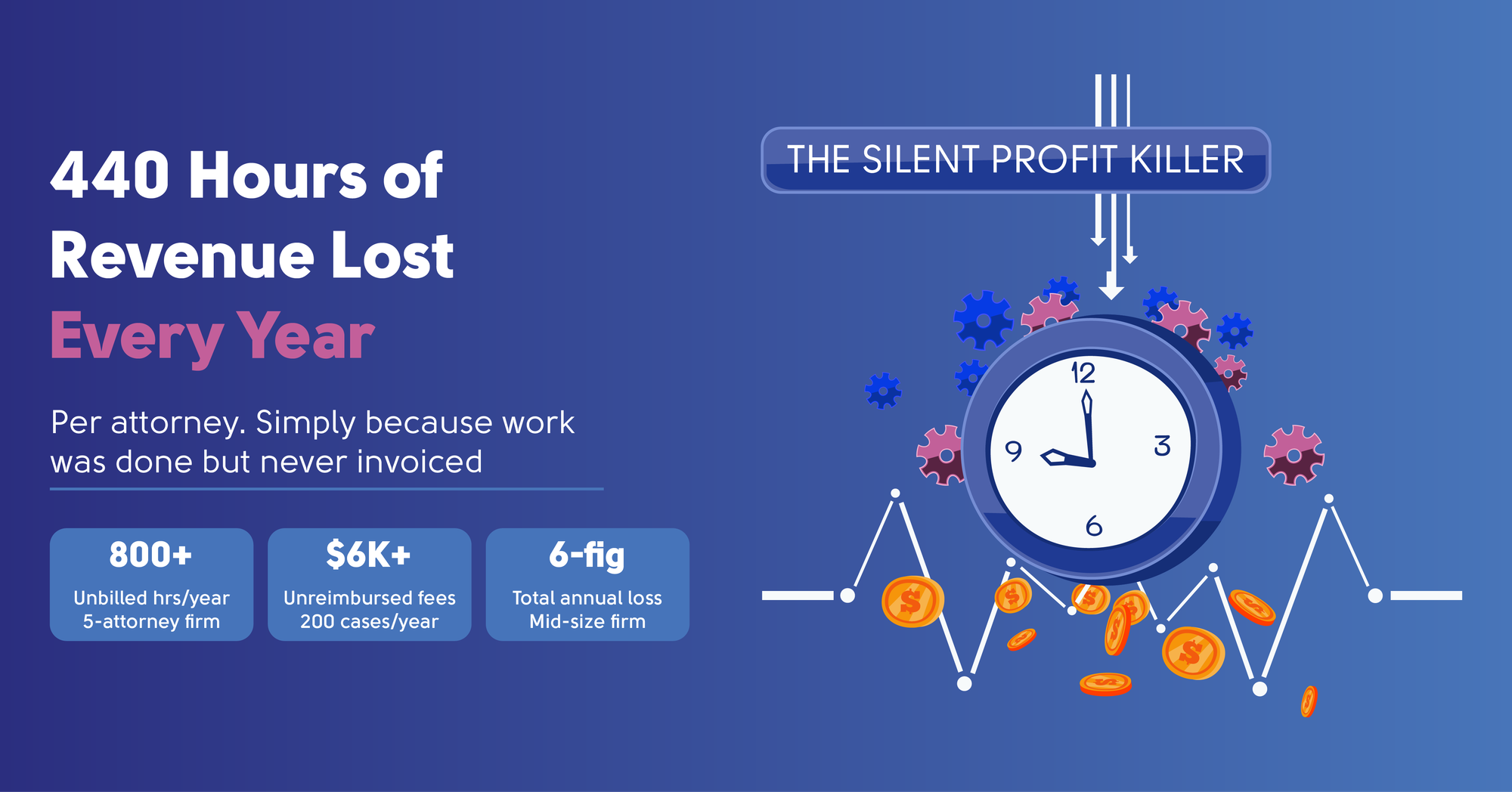
Unbilled phone calls and short consultations. An attorney who takes four client calls per day, each averaging ten minutes, has 40 minutes of billable time. If two of those calls go unlogged, the firm loses 20 minutes per attorney per day. Across five attorneys over a year, that is more than 800 hours of revenue that never appeared on an invoice.
Paralegal preparation time not captured. A paralegal who spends three hours preparing an H-1B petition and logs two and a half hours because the last thirty minutes was spent on hold with a USCIS inquiry line that ended up informing the preparation loses half an hour per petition. Across 60 H-1B petitions in a filing season, that is 30 hours gone.
RFE response work that exceeds the original case estimate. An H-1B case quoted at a flat fee generates an RFE that takes eight attorney hours to respond to. If the firm's flat-fee arrangement does not include RFE response work as a separately billable item, and the attorney does not raise the issue with the client, that eight hours is absorbed.
Expenses not tracked. A firm that processes 200 cases per year and spends an average of $30 per case on disbursements that go unbilled is absorbing $6,000 annually in reimbursable costs that simply never appeared on an invoice.
None of these are catastrophic individually. Together, for a firm of five attorneys handling moderate volume, the total revenue leakage from these sources can easily reach six figures annually.
What Integrated Billing Software Changes
The core insight behind effective immigration billing software is simple: billing should be a byproduct of case activity, not a separate administrative task.
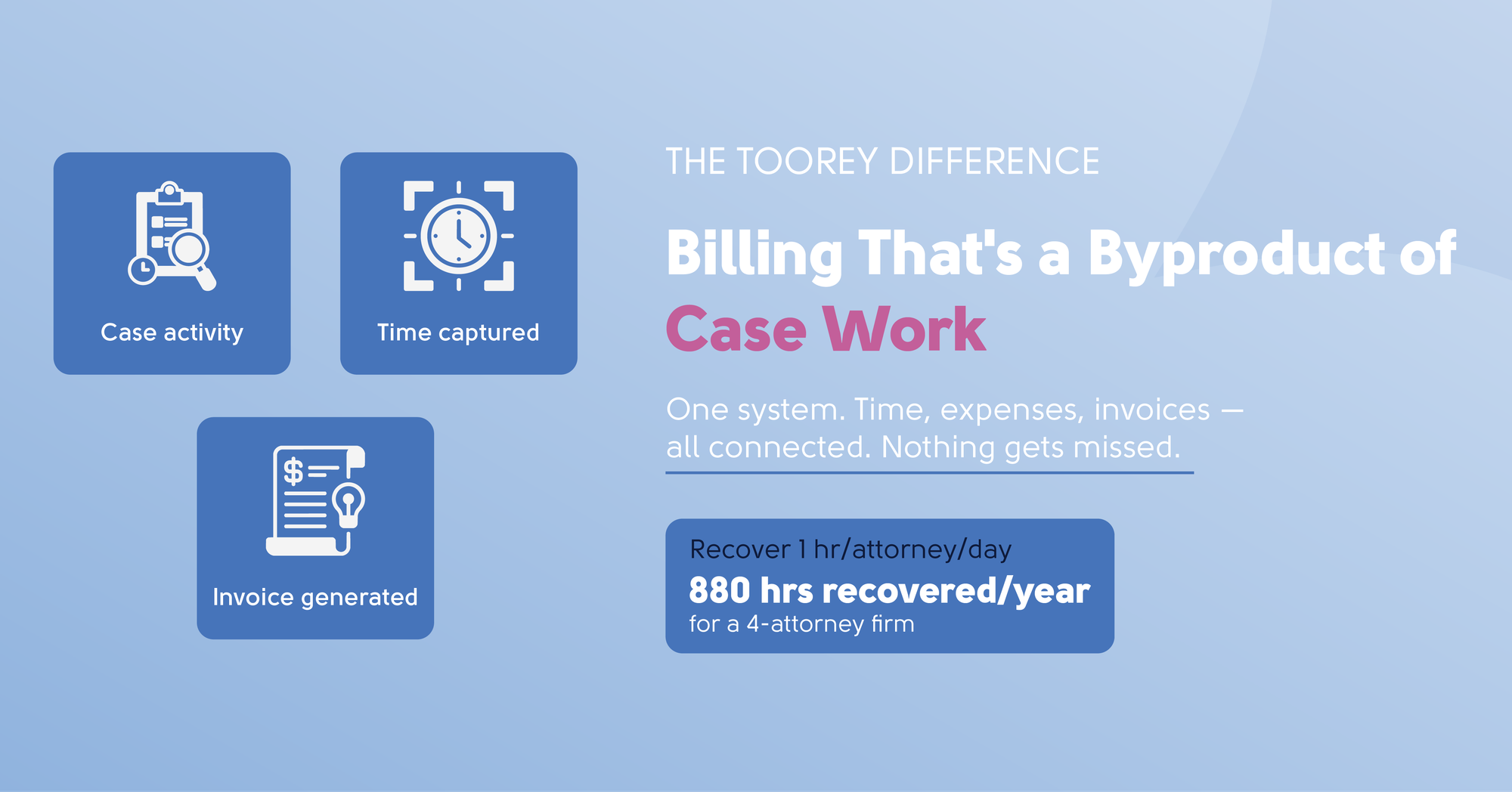
When billing is integrated into case management, time entries happen in the context of the work being done. When an attorney reviews a USCIS notice in the case record, they log the time immediately in the same interface. When a paralegal completes a form preparation task, they log their time against the case as the task is marked complete. When a filing fee is paid, it is recorded as a case expense automatically. Nothing requires memory. Nothing requires a separate login or a manual transfer between systems.
This is the model Toorey is built on. Billing and case management are not separate modules that integrate with each other. They are a single connected system where case activity and billing activity are recorded in the same place by the same people at the same time.
The practical effects of this integration are measurable.
Time capture rates increase. When logging time is frictionless and happens in the context of actual work, attorneys and paralegals log more of their time. The small increments that previously went unlogged because opening a separate billing system felt disproportionate to a ten-minute task now get captured because the log is right there in the case record.
Paralegal time is captured consistently. When billing is integrated into the workflow that paralegals already use, their time is captured with the same discipline as attorney time rather than as an afterthought.
Expenses are tracked automatically. Filing fees, courier costs, and other disbursements tied to case actions are recorded as they happen rather than reconstructed from memory at invoicing time.
Invoicing is faster and more accurate. When an invoice is generated in Toorey, it draws from a complete record of time entries and expenses logged against the case. The attorney reviews and approves it rather than building it from scratch. The time from work completion to invoice delivery drops significantly, which also improves cash flow.
Flat-fee cases become visible. When time is tracked against flat-fee cases even when it is not directly billed, the firm can see exactly which case types are consistently over-budget. That data drives better pricing decisions and better client conversations about scope.
The Billing Conversation Most Firms Are Not Having
There is a conversation that does not happen at most immigration firms that should.
Typically, billing is reviewed at the individual attorney level: did I meet my billing targets this month? But the more important question is systemic: what is the gap between work done and work invoiced across the practice, and where is that gap widest?
Without integrated billing, this question is essentially unanswerable. The data to answer it does not exist in one place in a usable form.
With integrated billing, it becomes a standard management report. Which attorneys have the lowest time-capture rates? Which case types consistently run over their fee estimates? Which paralegals are logging their time consistently and which are not? Which clients have outstanding balances that are aging past the firm's standard terms?
These are the questions that move the revenue needle for a growing immigration firm. Answering them requires not just billing software but billing software that is connected to the case management system where the actual work happens.
What to Look for in Immigration Billing Software
If you are evaluating billing capabilities as part of a practice management platform, these are the features that actually close the leakage gap.
In-context time tracking. Time entry should be possible directly from the case record, without switching to a separate application. The lower the friction of logging time, the higher the capture rate.
Paralegal time tracking at the task level. The system should make it as easy for a paralegal to log time against a task as it is for an attorney to log time against a case review.
Expense tracking tied to case actions. Filing fees, disbursements, and other reimbursable expenses should be recordable in the case record as they occur, not reconstructed at invoice time.
Flat-fee case tracking. Even on fixed-fee cases, the system should support time logging so the firm can see actual cost against fee and make informed decisions about pricing.
Integration with accounting tools. QuickBooks, Stripe, and similar tools should connect natively so billing data flows into the firm's financial systems without manual export and re-entry.
Invoice generation from case records. Invoices should be generated from logged time and expenses in the case record, not assembled manually. The attorney's role is to review and approve, not to reconstruct.
Accounts receivable visibility. The firm should be able to see outstanding balances across all clients without leaving the case management platform, with clear aging so follow-up on overdue invoices is systematic rather than reactive.
Toorey's billing integration covers all of these. Attorneys and paralegals log time in the case record where they work. Expenses are tracked as case actions. Invoices draw from complete case records. Integration with Stripe and QuickBooks means billing data flows to financial systems without manual transfer. And the firm has real-time visibility into what has been invoiced and what is outstanding across every active case.
The Revenue Math
If the average immigration firm recovers one additional hour of billable time per attorney per day through better billing capture, and that hour is billed at a modest rate, the annual revenue impact per attorney is substantial. For a firm of four attorneys, that is four hours per day recovered, 880 hours per year, at whatever the blended billing rate is.
The cost of integrated billing software is small relative to that recovery. For most firms, the billing improvement alone covers the platform cost many times over, before accounting for the value of the case management, deadline tracking, AI drafting, and paralegal support features that come with it.
Revenue leakage is a solvable problem. But it requires a system where billing is a natural output of case work rather than a separate administrative discipline that competes with it for attention.
Toorey's integrated billing keeps time capture, invoicing, and case management in one place so nothing that should be billed ever gets missed. See how at toorey.com.