How AI Drafting Is Changing What Immigration Attorneys Can Do in a Day
There is a before and after moment for most immigration attorneys who start using AI drafting tools seriously. Before, writing a support letter for an H-1B petition took 45 minutes to an hour, every time, for every case. After, the first draft exists in minutes. The attorney reads it, refines the argument, sharpens the language, adds the case-specific details that only they know, and the letter is done in 20 minutes rather than an hour.
Multiply that across an H-1B season with 60 petitions. Multiply it across RFE responses, cover letters, employer letters, and the dozens of other documents that immigration practice generates. The time savings are not marginal. They are structural. They change what a single attorney can accomplish in a day, in a week, across an entire filing season.
This is not a future development. It is happening now, in practices of every size, and the gap between firms using AI drafting well and firms that have not yet adopted it is already measurable in case capacity, turnaround time, and attorney bandwidth.
What AI Drafting Actually Does in an Immigration Workflow
The most important thing to understand about AI drafting in immigration practice is that it is not a writing tool. It is a case analysis and document generation tool that happens to produce written output.
When an AI drafting system is working properly, it is not simply generating generic legal language. It is reading the case record: the beneficiary's qualifications, the employer's business, the job description, the visa category requirements, the specific issues at stake. It is analyzing that information against the legal standards that apply to the case type. And it is generating a first draft that is specific to that case, structured around the relevant legal argument, and built from the actual facts in the file.
That is meaningfully different from a template. A template gives you structure. AI drafting gives you a structured argument built from your case data.
Toorey's AI drafting works exactly this way. When an attorney initiates a draft in Toorey, the system pulls from the case record, analyzes the relevant legal standards for the visa category, and generates a complete first draft of the support letter, cover letter, or RFE response. The draft arrives with the case-specific facts already incorporated, the legal argument already structured, and the key issues already addressed.
What the attorney does next is the part that matters most.
The "AI Drafts, Attorney Approves" Model
The only AI drafting model that works in legal practice is one where the attorney is genuinely in control of every final output. Not nominally in control. Actually in control, with the time and visibility to review the draft meaningfully and the judgment to refine it into something that meets their professional standards.
This matters for two reasons. The first is professional responsibility. Every document that goes out under an attorney's name is their work product, regardless of how the first draft was generated.
Bar guidance on AI use in legal practice is consistent on this point: attorneys must supervise AI output, must review it for accuracy and appropriateness, and are fully accountable for the final product. Ignorance of what the AI produced is not a defense.
The second reason is quality. AI drafts are good starting points. They are not finished products. They can misweight case-specific facts. They can apply a standard argument where the case requires a nuanced one. They can generate fluent, well-structured language that is legally correct in general terms but wrong for this particular case. An attorney who treats AI output as final without careful review is taking a professional risk and doing their client a disservice.
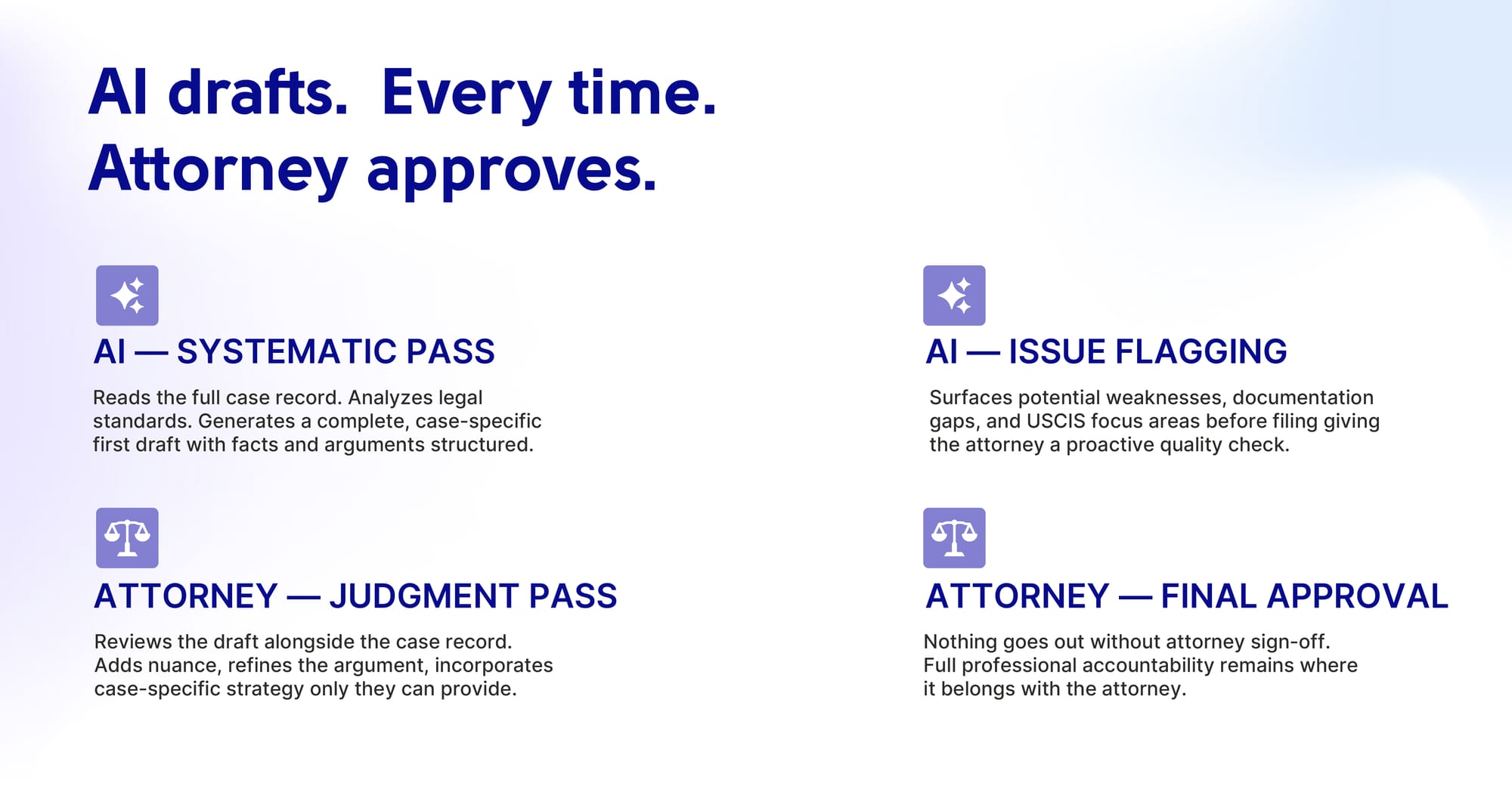
Toorey is built around this principle at the design level. The attorney review step is not optional or informal. It is structured into the workflow. The AI generates the draft, flags the issues it identified in the case analysis, and surfaces the draft for attorney review with the case record accessible alongside it. The attorney reads, refines, adds what only they know, and approves. Nothing goes out without that step.
This is not a limitation. It is the right model. It allocates the work to the party best suited to each part: AI for the systematic, pattern-based, time-consuming first pass; attorney for the judgment, nuance, and accountability that only they can provide.
What Gets Drafted and What Does Not
AI drafting is most valuable for the documents in immigration practice that share a common structure across cases but require case-specific content to be compelling. These are the documents that take the most paralegal and attorney time to produce and where the quality of the first draft most directly affects the quality of the final product.
H-1B support letters. The employer support letter for an H-1B petition follows a predictable structure: description of the petitioning organization, description of the proffered position and its requirements, explanation of why the role qualifies as a specialty occupation, and description of the beneficiary's qualifications. AI drafting generates this structure with the specific employer, role, and beneficiary details from the case record incorporated throughout. The attorney refines the specialty occupation argument and adds the strategic framing that the case requires.
RFE responses. This is where AI drafting delivers some of its most significant time savings. An RFE response for a specialty occupation issue on an H-1B follows a known structure, addresses known USCIS concerns, and draws on a known body of legal argument. AI drafting generates a complete response framework from the case record and the specific RFE issues, which the attorney then shapes into the precise argument the case requires. The difference between spending eight hours on an RFE response and spending four is almost entirely in the drafting phase.
Cover letters. Filing cover letters are systematic by nature: they describe the case, list the enclosed documents, and direct the adjudicator's attention to the key evidence. AI drafting handles this reliably and quickly, freeing attorney and paralegal time for work that requires more judgment.
I-140 and other petition narratives. Employment-based green card petitions, National Interest Waiver cases, and O-1 extraordinary ability petitions all require substantive narratives that draw on specific case evidence. AI drafting gives attorneys a solid structural starting point that they then develop into the specific argument the case requires.
The documents where AI drafting adds less value are the ones that are primarily strategic or highly individualized: a complex legal brief where the argument is genuinely novel, a letter to a specific USCIS officer addressing a procedural history, or a client advisory that requires nuanced judgment about a fact-specific situation. These remain primarily attorney work. AI drafting does not claim otherwise.
The Case Analysis Layer
Beyond drafting, Toorey's AI does something that most attorneys find equally valuable once they start using it: case analysis.
Before the attorney even opens a new matter to begin work, the AI has reviewed the case record and surfaced a structured analysis. What are the strongest elements of this case? Where are the potential weaknesses? What documentation gaps exist that should be addressed before filing? What issues is USCIS likely to focus on for this case type under current adjudication standards?
This analysis does not replace attorney judgment. It informs it. An experienced immigration attorney reading a case analysis from Toorey is not being told what to think. They are seeing a systematic review of the case that surfaces issues they might otherwise catch only after deeper review, and they can apply their own judgment to assess and respond to each one.
For attorneys managing high case volumes, this layer of proactive case analysis is a meaningful quality control mechanism. It reduces the risk that a case with a solvable problem goes to filing without the problem being addressed, simply because the volume of active cases made a thorough manual review of each file difficult to complete.
What Changes at the Practice Level
The cumulative effect of AI drafting and case analysis on an immigration practice is not just efficiency. It is a change in the ratio of cases to attorney time that the practice can sustain at quality.
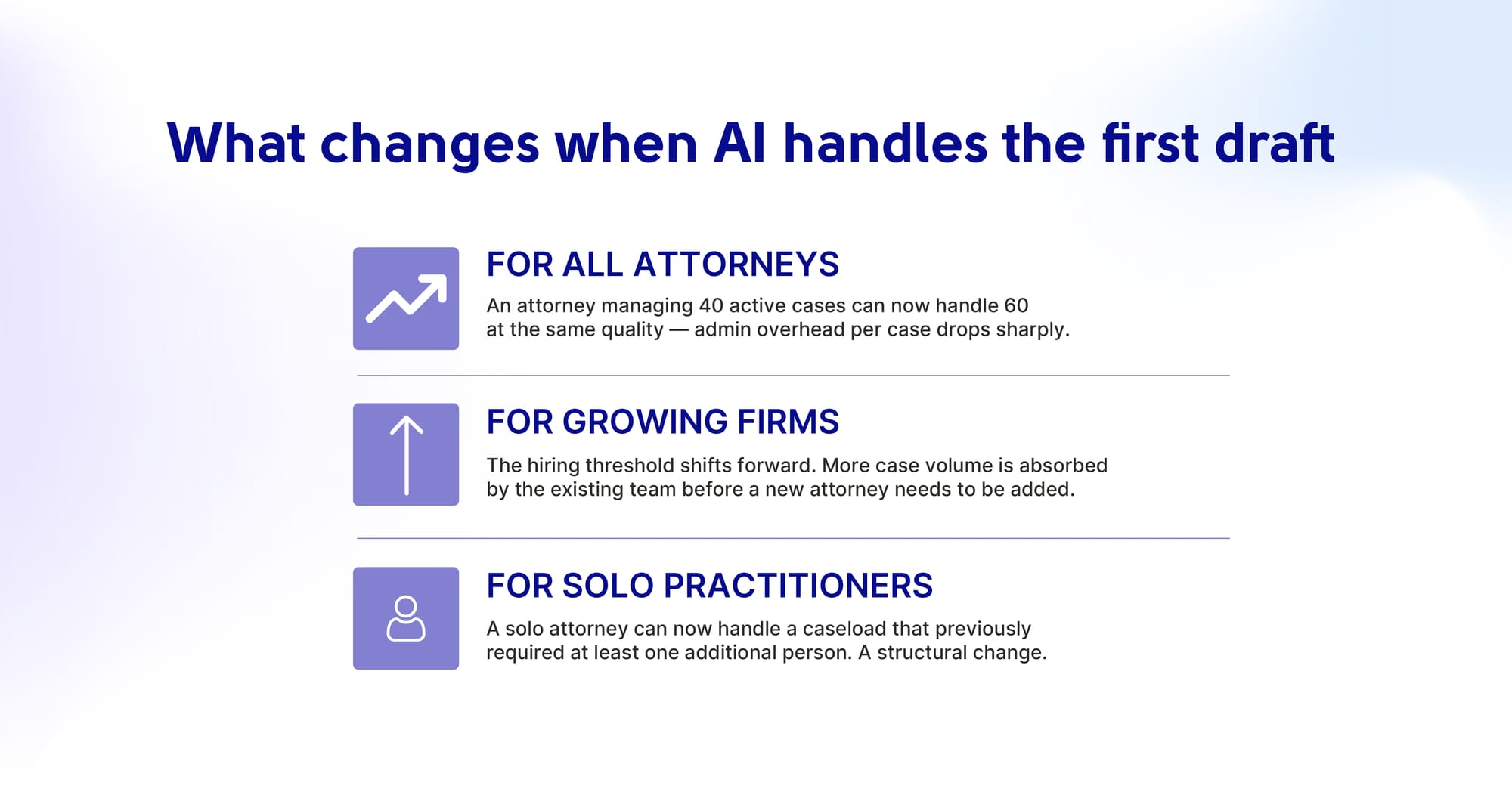
An attorney who was productively managing 40 active cases can now manage 60 with the same working hours and the same quality standards, because the administrative overhead per case has dropped substantially. An attorney who was spending 30 percent of their time on drafting tasks can now spend that time on client counsel, business development, or the legal strategy work that only they can do.
For growing firms, this changes the hiring calculus. The point at which a practice needs to add an attorney to maintain quality shifts forward. More case volume can be absorbed by the existing team before that threshold is reached.
For solo practitioners, the effect is even more direct. A solo attorney with AI drafting support can handle a caseload that previously required at least one additional person to execute well. That is not an incremental improvement. It is a structural change in what a solo practice can be.
Getting AI Drafting Right
The firms using AI drafting most effectively share a few common practices worth noting.
They treat AI drafts as first drafts, always. No AI output goes out without attorney review, and that review is substantive rather than cursory. They have built the review step into their workflow in a way that ensures it happens reliably, not just when time permits.
They use the case analysis output actively. Rather than treating the AI's case analysis as a report to be acknowledged and filed, they use it as a working document that shapes their preparation strategy for each matter.
They give attorneys time to develop fluency with the tool. AI drafting improves with use as attorneys learn what the system does well, where to focus their review, and how to incorporate their own judgment most effectively. Firms that invest in that learning curve see better outcomes than firms that expect immediate results with minimal adjustment.
And they choose platforms where AI is native to the case management workflow rather than bolted on. When drafting and case analysis live inside the same system as the case record, the AI has access to complete, current case data and the attorney review step is integrated into the workflow rather than an additional step outside it.
This is what Toorey is built to deliver: AI drafting and case analysis that is native to the case management platform, structured around the attorney-approval model, and designed to make the attorney more capable rather than less accountable.
See Toorey's AI drafting and case analysis tools in action. Book a demo at toorey.com.