Client Portal for Immigration Law Firms: Why It Changes Everything
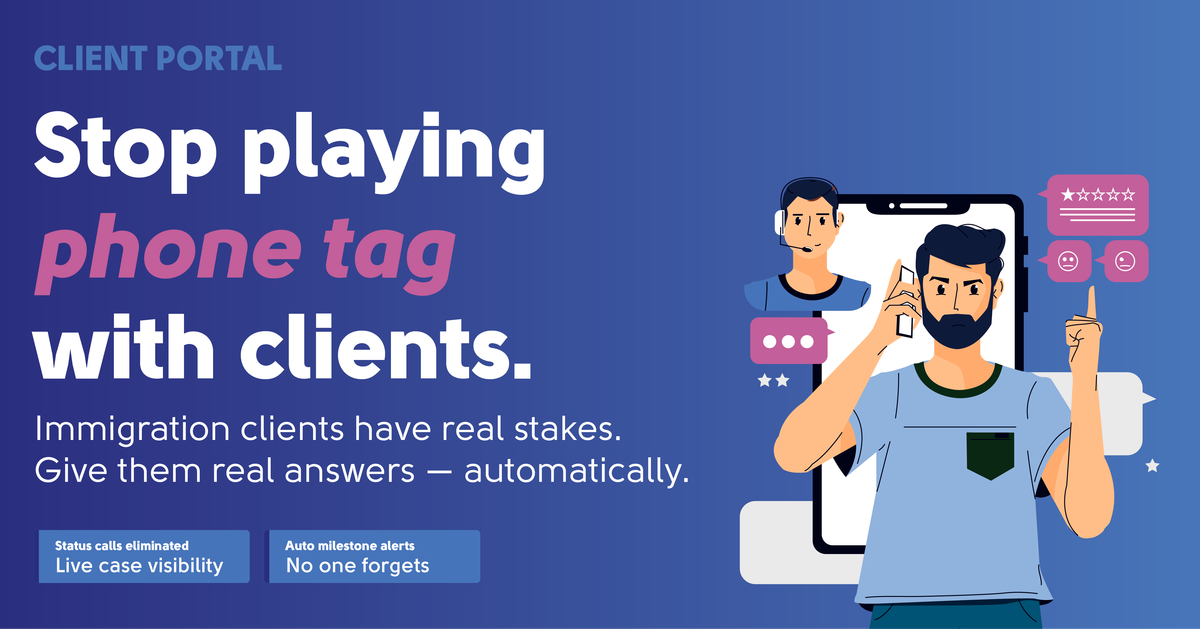
Most immigration attorneys spend more time communicating with clients than they realize. Not on legal counsel or strategy. On status updates, document reminders, follow-up calls, and answering the same questions that every client asks at roughly the same stage of every case.
Where is my case? Did you receive the documents I sent? What do I still need to submit? When will this be filed? Is there anything I need to do right now?
These are reasonable questions. Clients dealing with visa petitions, green card timelines, and work authorization have genuine stakes in the answers. The problem is not that clients ask them. The problem is that answering them, individually, for every client, on demand, consumes an enormous amount of attorney and paralegal time that could go toward advancing the actual case.
A well-built client portal eliminates most of this. Not by ignoring clients or giving them less access. By giving them more: real-time visibility into their case status, a direct channel for document submission, and automatic updates when things happen. The client is more informed than before. The attorney and paralegal spend significantly less time on status communication.
That is not a minor efficiency gain. For a firm handling moderate volume, recovering the time currently spent on reactive client communication is one of the highest-leverage operational improvements available.
What a Client Portal Actually Does
The phrase "client portal" covers a range of capabilities, and immigration firms evaluating software should understand the difference between a basic document-sharing tool and a genuinely integrated case portal.
A basic portal gives clients a place to upload documents and view some case information. That is useful. It is not transformative.
A genuinely integrated client portal connects directly to the live case record. When the paralegal updates case status, the client sees it. When a milestone is reached, the client receives an automatic notification. When a document is needed, the client receives a structured request that tells them exactly what to submit, where to submit it, and by when. When the client uploads a document, it lands directly in the correct section of the case record, correctly categorized, without anyone having to process an email attachment and manually file it.
This level of integration changes the dynamic between the firm and the client in ways that go beyond communication efficiency.
Toorey's client portal operates this way. It is not a separate communication layer attached to the case management system. It is a client-facing view of the live case record, with structured intake, document submission, status visibility, and automatic milestone notifications built in.
The Intake Transformation
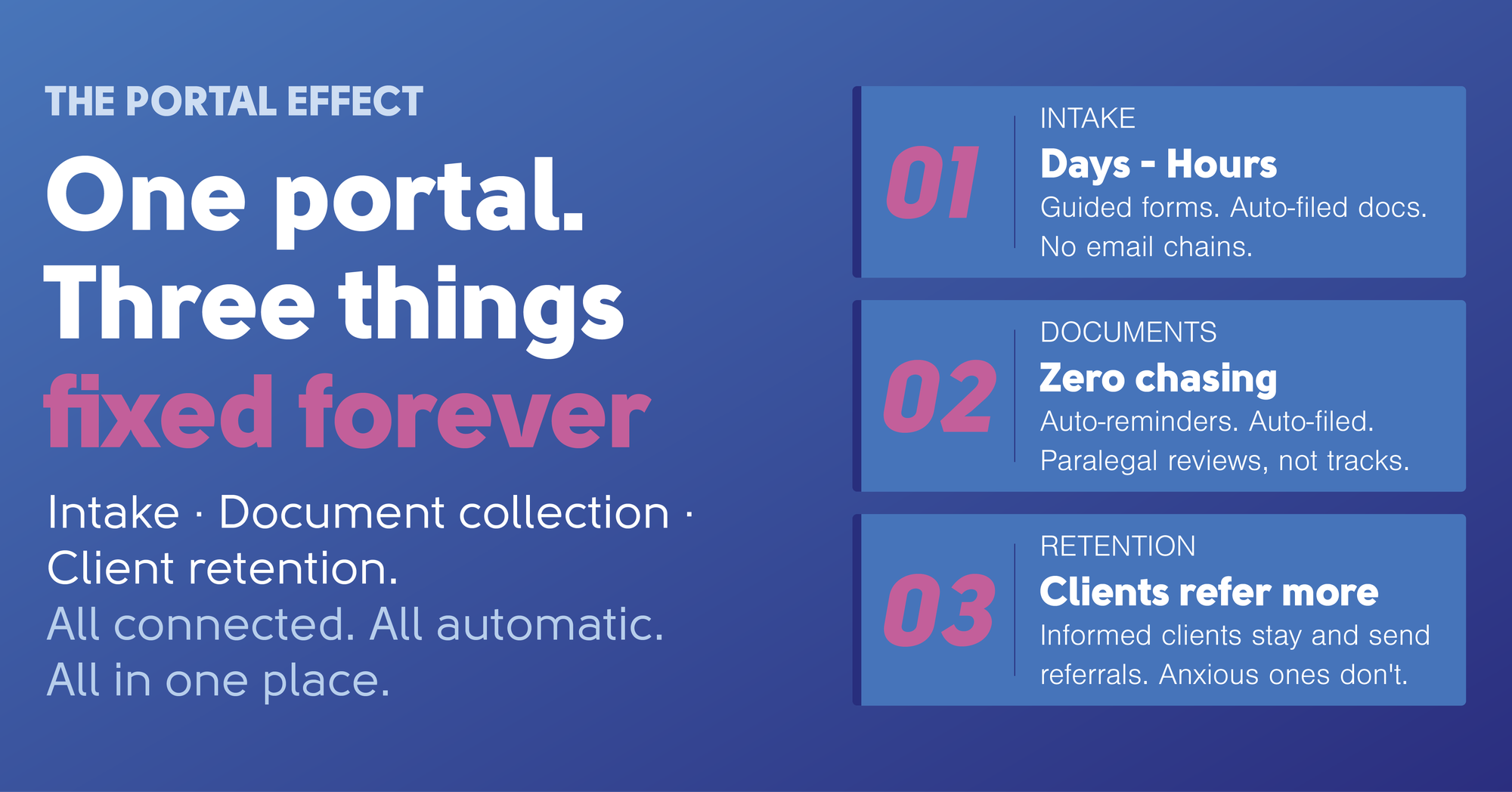
The most immediate impact of a client portal on most immigration firms is in intake. The process of collecting the information and documents needed to open and prepare a new case is one of the most time-consuming and error-prone parts of immigration practice. And it happens at the beginning of every single case.
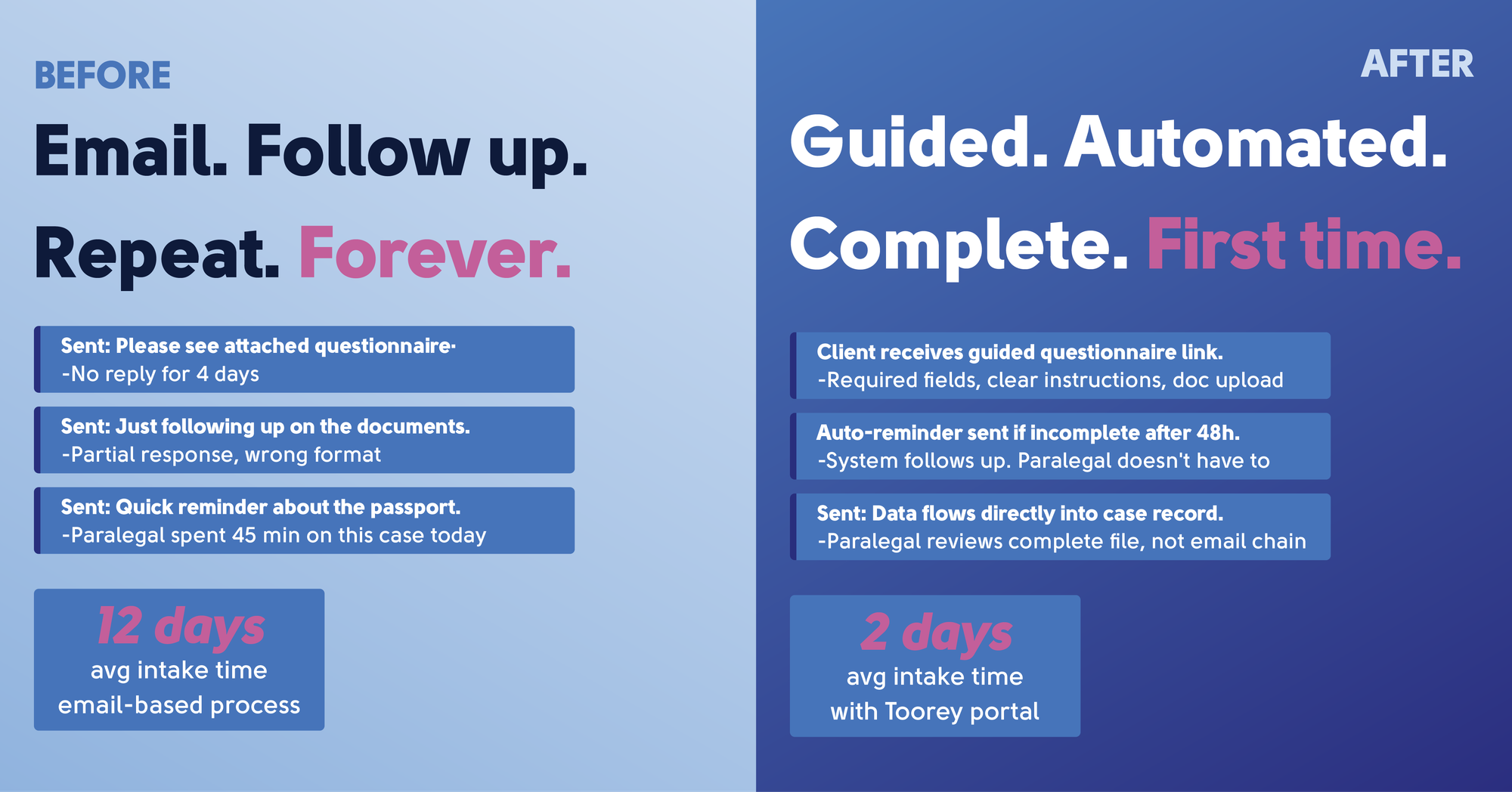
Traditional intake looks something like this. The attorney or paralegal sends the client a PDF questionnaire by email. The client fills it out, sometimes incompletely, and sends it back by email. The paralegal reviews it, identifies gaps, sends follow-up questions by email. The client responds, sometimes addressing all the gaps and sometimes creating new ones. Documents are requested by email, received by email, downloaded from email attachments, renamed, and filed manually into the case record. The whole process takes days, sometimes weeks, and requires multiple rounds of back-and-forth that each add delay.
A structured client portal intake replaces this entirely. The client receives a link to a questionnaire built specifically for their case type: the right questions, in the right order, with clear explanations of what is being asked and why. Required fields cannot be left blank. Document upload categories are pre-defined so the client knows exactly what to submit and where. Incomplete submissions trigger automatic reminders rather than requiring a paralegal to track and follow up manually.
When the client completes intake through the portal, the data flows directly into the case record. Form fields are pre-populated. Documents are filed in the correct categories. The paralegal's first interaction with the case is not processing an email chain but reviewing a complete, organized intake record and identifying any items that still need attention.
The time difference between these two processes, across a full year of case openings, is substantial. Toorey firms that have moved from email-based intake to portal intake consistently report faster case readiness and significantly less paralegal time on intake coordination.
Document Collection Without the Chase
After intake, document collection is the ongoing operational challenge that a client portal addresses most directly.
Immigration cases require documents at multiple stages: initial intake documents, employer documentation for employment-based cases, supporting evidence for petition preparation, government-issued responses that clients receive and need to forward. Getting these documents from clients and employers is one of the most consistent sources of delay in immigration practice.
The traditional approach is email-based: the paralegal sends a request, the client responds when they get around to it, the paralegal follows up if they do not, and the whole process runs on individual follow-through and informal reminders.
A client portal with integrated document collection works differently. When a document is needed, a structured request is sent through the portal specifying exactly what is needed, in what format, and by what date. The client receives an alert, sees the request in their portal with clear instructions, and uploads the document directly. The portal sends automatic reminders at defined intervals if the document has not been submitted. The paralegal does not have to remember to follow up because the system does it automatically.
The document arrives in the case record, correctly filed, with a timestamp and a record of when it was requested and when it was received. No email processing. No manual filing. No question about whether a document was received or where it was stored.
For firms managing high case volume, this automation recovers hours of paralegal time per week that was previously spent on document tracking and follow-up.
Real-Time Status Visibility and What It Does for Client Relationships
Immigration clients are anxious by nature of the subject matter. Their legal status, their ability to work, their family's ability to remain in the country: these are not abstract concerns. Uncertainty about case status makes that anxiety worse. Clients who do not know what is happening with their case call their attorney. They send emails. They worry.
An attorney who provides proactive, real-time case status visibility changes that dynamic entirely. The client does not need to call because they can see their case status in the portal whenever they want. They do not need to send an email asking if their documents were received because the portal shows when each document was uploaded and confirmed. They do not need to ask what happens next because the portal shows them the upcoming milestones.
This has a direct effect on client satisfaction and retention that shows up in referrals and reviews. Clients who felt informed and supported throughout their case are the ones who recommend the firm to others. Clients who felt left in the dark, even when the legal work was excellent, often do not.
There is also a practice management effect that is less obvious but equally important. When the attorney knows that clients are receiving automatic status updates through the portal, they are freed from the background obligation of proactive outreach that many attorneys feel. The communication is happening systematically. The clients are informed. The attorney can focus on the legal work without the persistent low-level worry that someone has not heard anything in two weeks.
Automatic Milestone Notifications
Status visibility in the portal is passive: the client can check their case status whenever they want. Milestone notifications are active: when something happens, the client is informed automatically, without anyone having to remember to send an update.
In practice, this means clients receive notifications when their petition is filed, when a receipt notice is received and logged, when a USCIS decision arrives, when an action is required from them, and when any significant case milestone is reached.
For corporate clients managing employee visa programs, these notifications are particularly valuable. HR teams tracking the status of multiple employee petitions can stay informed without contacting the firm for every update. That reduces inbound communication volume significantly while keeping clients better informed than they were when they had to ask for every update.
The Secure Communication Channel
Beyond status visibility and document collection, a client portal provides a secure, documented channel for case-related communication that is meaningfully better than email for both the firm and the client.
Messages sent through the portal are tied to the case record. They are visible to every authorized team member. They are documented and searchable. They cannot be accidentally sent to the wrong address. And they are encrypted in transit and at rest in a way that a standard email service is not.
For immigration attorneys, the security dimension is not trivial. Client communications in immigration cases contain sensitive personal information: immigration status, family details, financial records, employer information. That information deserves better protection than most email services provide.
Toorey's client portal uses the same enterprise-grade encryption, AES-256 at rest and TLS 1.3 in transit, that protects the rest of the platform. Messages and documents exchanged through the portal are protected at the same standard used by major financial institutions.
What Changes at the Practice Level
The cumulative effect of a well-integrated client portal on an immigration practice is not just operational efficiency. It is a change in what the firm's capacity looks like.
Every hour recovered from status calls and document-chasing emails is an hour that can go to legal work, to business development, or to handling additional cases. For a firm that is approaching its capacity ceiling, the portal can materially extend how many cases the existing team can manage before additional hiring is necessary.
Client satisfaction improves because clients feel informed and supported. Referrals increase. The firm's reputation for responsiveness is built on a system rather than on the inconsistent individual habits of each attorney and paralegal.
And the practice as a whole becomes more resilient. When client communication runs through a platform rather than through individual email inboxes, it does not disappear when a team member is out. It is visible to everyone. It continues functioning regardless of who is in the office on any given day.
For a growing immigration firm, these are not incremental improvements. They are structural changes in how the practice operates. And they all follow from a single design decision: building a client portal that is genuinely integrated with the case management system, not attached to it loosely as a secondary feature.
Toorey's integrated client portal gives immigration clients real-time case visibility while eliminating the status calls and document-chasing that consume attorney and paralegal time. See how at toorey.com.