What to Look for in Immigration Law Practice Management Software (And Where Most Platforms Fall Short)

The immigration software market has grown quickly, and that's mostly a good thing for law firms. More options mean more competition, and competition has pushed the quality of available tools upward.
But it has also created a noisier market. Every platform claims to be purpose-built for immigration attorneys. Every demo looks clean. Every sales deck leads with the same promises: save time, reduce errors, scale your practice.
Once you get past the marketing, the differences between platforms become significant. Some are genuinely built for how immigration law works. Others are adapted from generic legal software and retrofitted with immigration-specific features that don't quite fit. A few are strong in one area, such as form preparation, but leave critical gaps elsewhere.
This piece lays out the criteria that actually matter when evaluating immigration practice management software, and where many platforms quietly fall short.
The "Immigration-Specific" Test
The first question to ask about any platform is whether it was built for immigration law from the ground up, or whether it started as a general legal tool and added immigration features later.
This distinction is not just cosmetic. Immigration law has a specific set of workflows, form requirements, USCIS filing processes, and compliance obligations that do not map cleanly onto general legal practice management structures. A platform built around generic case management and then extended for immigration will always feel slightly off: workflows that require workarounds, form libraries that lag behind USCIS updates, and case structures that weren't designed with visa categories in mind.
The best platforms are structured around how immigration cases actually move. Intake flows into case setup. Case setup maps to specific visa categories with pre-built workflows. Documents are organized around immigration-specific milestones. Deadlines are tied to USCIS filing windows, not just calendar dates. USCIS form libraries are current and auto-populated from case data.
When evaluating a platform, ask to see an H-1B workflow and a family-based green card workflow without the sales rep setting it up for you first. What you see out of the box tells you more than any feature checklist.
Unified vs. Stitched Together
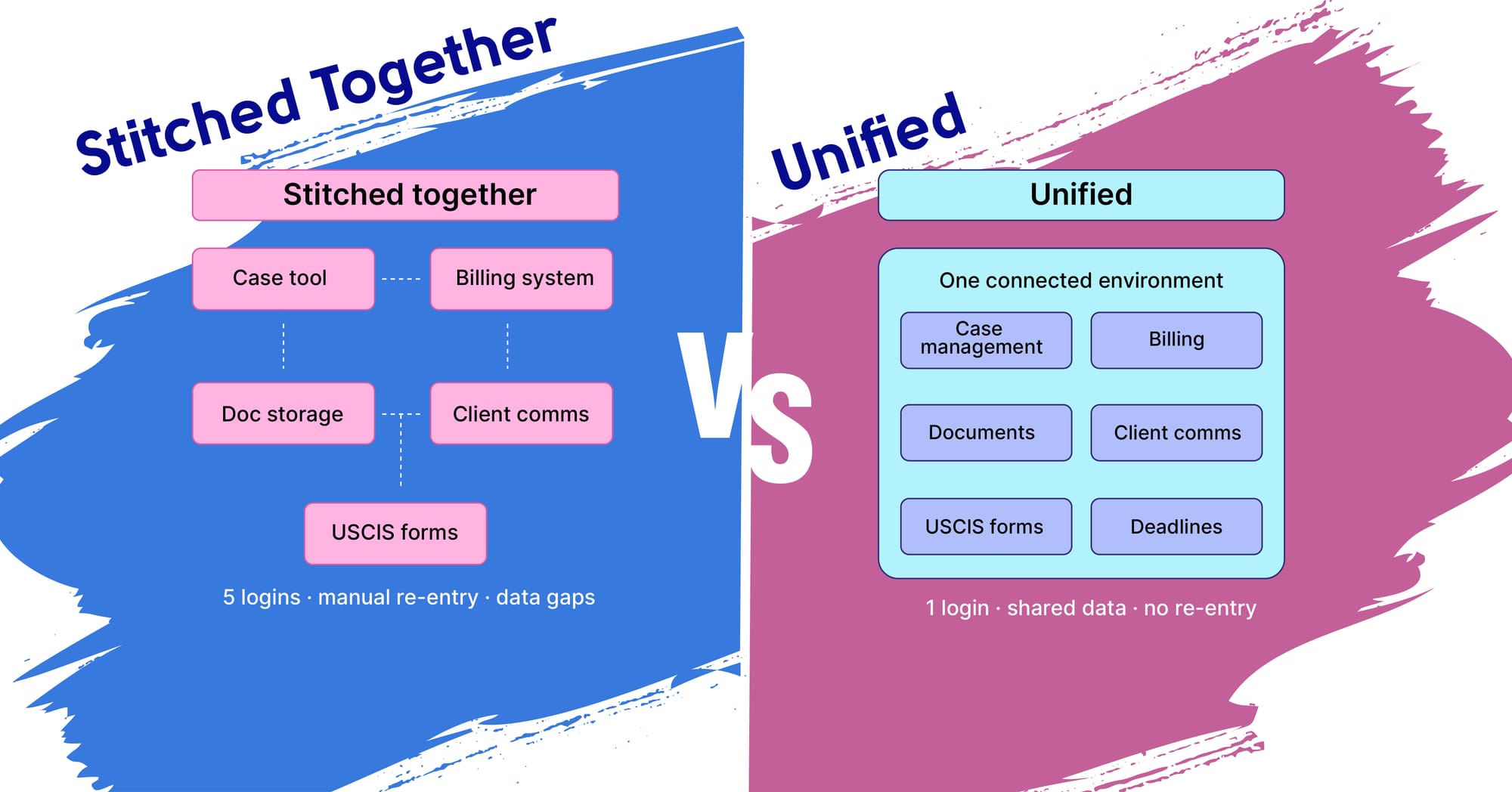
One of the most common failure modes in immigration software is a platform that handles one part of practice management well but requires other tools to fill the gaps.
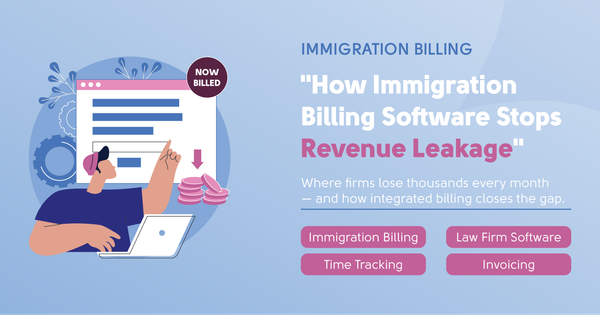
A case management tool that doesn't include billing requires a separate invoicing system. A billing system that isn't connected to case activity requires manual time entry. A document management layer that lives outside the case record requires attorneys to switch between systems constantly. A client communication tool that is disconnected from case status creates the conditions for inconsistent updates and missed follow-ups.
Every seam between tools is a place where things fall through. Every separate login is a place where time gets lost. Every disconnected system is a potential source of data inconsistency.
The strongest immigration platforms are genuinely unified: one environment where case management, document storage, deadline tracking, client communications, USCIS filing, billing, and compliance all live together and share data. Not integrations that approximate this, but actual unification.
This is worth scrutinizing carefully in any demo. Ask to trace a case from intake all the way through to invoice without leaving the platform. The points where the workflow breaks or requires a workaround are the points where the platform is stitched together rather than unified.
Toorey is built as a complete operating system for immigration practice: intake to approval, filing to billing, all in one connected environment. The data flows across the entire lifecycle without re-entry or system switching.
The Paralegal Gap
Software does not solve a staffing problem. This is one of the most important and consistently underacknowledged gaps in the immigration software market.
A platform that gives a solo attorney or lean team powerful tools to manage cases more efficiently still requires someone to manage cases. If a firm is bottlenecked by paralegal capacity, more sophisticated software speeds up the parts of the work that are already getting done while leaving the bottleneck in place.
Most platforms offer tools to manage paralegals. Very few offer actual paralegal support as part of the service. This is a meaningful distinction for firms trying to scale case volume without proportionally scaling headcount.
Toorey goes beyond software by supplying trained paralegals who work within the platform to handle filings, follow-ups, document requests, and USCIS notices. Attorneys stay focused on legal judgment and strategy. The operational work moves through the system without requiring attorneys to be the ones coordinating it.
For a firm evaluating platforms, this is a question worth asking directly: does your platform help me manage the paralegal work, or does it also help me get it done?
AI That Actually Does Something
AI has become a standard marketing claim across immigration software. Nearly every platform in the market mentions it. The range of what "AI" means in practice varies dramatically.
On one end: AI that auto-populates form fields from case data, which is genuinely useful but is really sophisticated data linking more than artificial intelligence in a meaningful sense.
On the other end: AI that analyzes a case's underlying strengths and weaknesses, generates a complete first draft of a support letter or RFE response, flags missing documentation, and surfaces actionable recommendations, all before the attorney opens the file.
The second category represents a real change in how much work an attorney can handle. The first is a useful feature that has been available in some form for years.
When evaluating AI capabilities, ask to see the drafting tool generate a document from a real case file, not a pre-staged demo. Ask where the AI pulls its information from and how it handles gaps in case data. Ask what the attorney review step looks like and whether it is built into the workflow or left to the attorney to manage independently.
Toorey's AI tools are built into the case workflow, not bolted on. AI drafts documents, analyzes cases, and flags risks. The attorney review step is structured and required. Every final decision stays with the attorney.
Deadline Tracking That Is Active, Not Passive
Deadline tracking is on every immigration software feature list. What that phrase means in practice ranges from "we store dates in a calendar" to "we proactively surface and escalate upcoming deadlines across all active cases with assigned ownership."
The gap between those two things is enormous in the context of immigration law, where a single missed filing window can be irreversible.
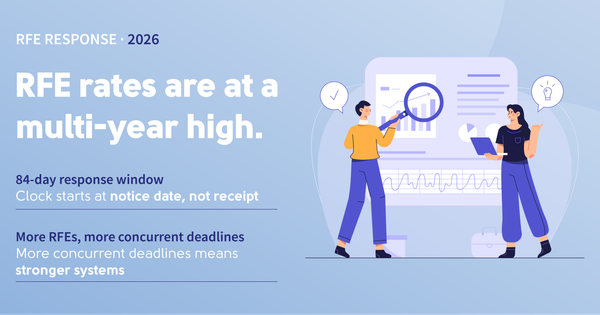
Passive deadline tracking stores dates and might send a reminder email. Active deadline tracking surfaces deadlines across your entire caseload before they become critical, assigns ownership to specific team members, escalates as the window closes, and integrates deadline status into the broader case view so nothing is hidden in a separate calendar.
Ask a platform to show you what happens when five cases have filings due in the same week. Can you see all of them in one view? Does the system tell you who is responsible for each? Does it escalate if an action is overdue? The answers to those questions separate deadline tracking from deadline management.
Security and Compliance: Certifications That Are Verified, Not Claimed
Immigration case data is extraordinarily sensitive. Passport numbers, financial records, employment history, family relationships, and immigration status are all in the system. The legal and professional consequences of a data breach are serious, and clients have every right to expect that their information is protected to the highest standard.
In this area, the gap between platforms is not always visible in a demo. It shows up in certifications, infrastructure decisions, and data handling policies.
Look for: SOC 2 Type II certification, which requires an independent audit of security controls over time, not just a point-in-time assessment. ISO 27001 certification for information security management. GDPR compliance if your practice handles data from EU residents. Encryption at rest and in transit using current standards. Granular permission controls that limit access by role. A complete audit trail of every action taken in the system.
Claims without certifications are not the same as certified compliance. Ask to see documentation, not just assurances.
Toorey holds SOC 2 Type II and ISO 27001 certifications, is GDPR compliant, and uses AES-256 encryption at rest with TLS 1.3 in transit as standard.
Onboarding and Support: What Happens After the Demo
The sales and demo experience at most platforms is polished. What matters more is what the experience looks like after you sign up.
Onboarding that takes 3-4 weeks and requires significant staff training time is a real operational cost. A platform that can get a firm up and running in days, with expert support from people who actually understand immigration law, is a meaningfully different proposition.
Ask about onboarding timelines. Ask who provides support after go-live and what their background is. Ask what happens when USCIS updates a form and how quickly that update reaches your platform. Ask whether you can request custom workflows or features, and what that process looks like.
Some platforms offer onboarding as a one-time setup event and then leave firms to self-serve through documentation and ticket queues. Others provide ongoing expert support from teams with immigration knowledge. The difference becomes clear quickly once you are past the demo stage.
Putting It Together: What a Strong Platform Looks Like
After working through these criteria, the profile of a strong immigration practice management platform becomes clear:
It was built specifically for immigration law, not adapted from a general legal tool. It unifies the entire case lifecycle, from intake to billing, in one connected environment. It offers either managed paralegal operations or robust tools to manage a strong internal team. Its AI capabilities go beyond population to genuine drafting assistance and case analysis, with a structured attorney review step. Its deadline tracking is active and surfaces issues proactively. Its security credentials are verified, not just claimed. And its onboarding and support are staffed by people who understand immigration law.
This is what Toorey is built to be: an all-in-one platform designed from the ground up for U.S. immigration law firms, combining AI-powered drafting, managed paralegal support, unified case management, and enterprise-grade security in a single connected system.
The Bottom Line
Most immigration platforms do some of this well. Fewer do all of it consistently. The platforms that fall short tend to do so in predictable ways: strong on case management, weak on billing integration. Strong on forms, weak on AI. Strong on the demo, inconsistent on post-sale support.
The firms that take time to evaluate against these criteria, rather than defaulting to name recognition or lowest price, end up with a platform that compounds their capacity over time rather than adding complexity to it.
See how Toorey performs against every criterion in this guide. Book a demo at toorey.com.