What Managed Paralegal Support Actually Means (And What It Doesn't)
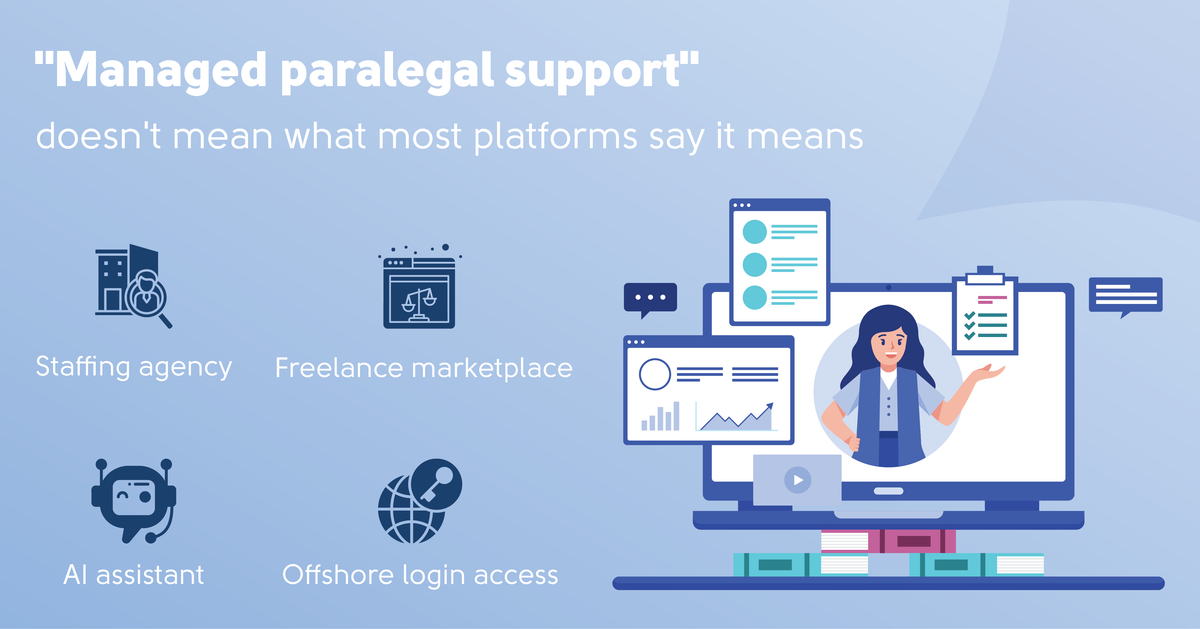
If you have been researching immigration practice management software recently, you have probably seen the phrase "managed paralegal support" more than once. It shows up in feature lists, landing pages, and sales decks. It sounds compelling. It also means very different things depending on who is saying it.
For some platforms, managed paralegal support means a marketplace where you can find freelance paralegals. For others, it means a directory of contractors you hire and manage yourself. For a few, it means something genuinely different: trained paralegals who work directly inside the platform, on your cases, with full visibility and accountability built in.
The difference between those things is significant. If your firm is evaluating whether this kind of support is right for you, this piece will help you understand exactly what you are being offered, what questions to ask, and what managed paralegal support looks like when it is done properly.
Why This Matters More Than It Might Seem
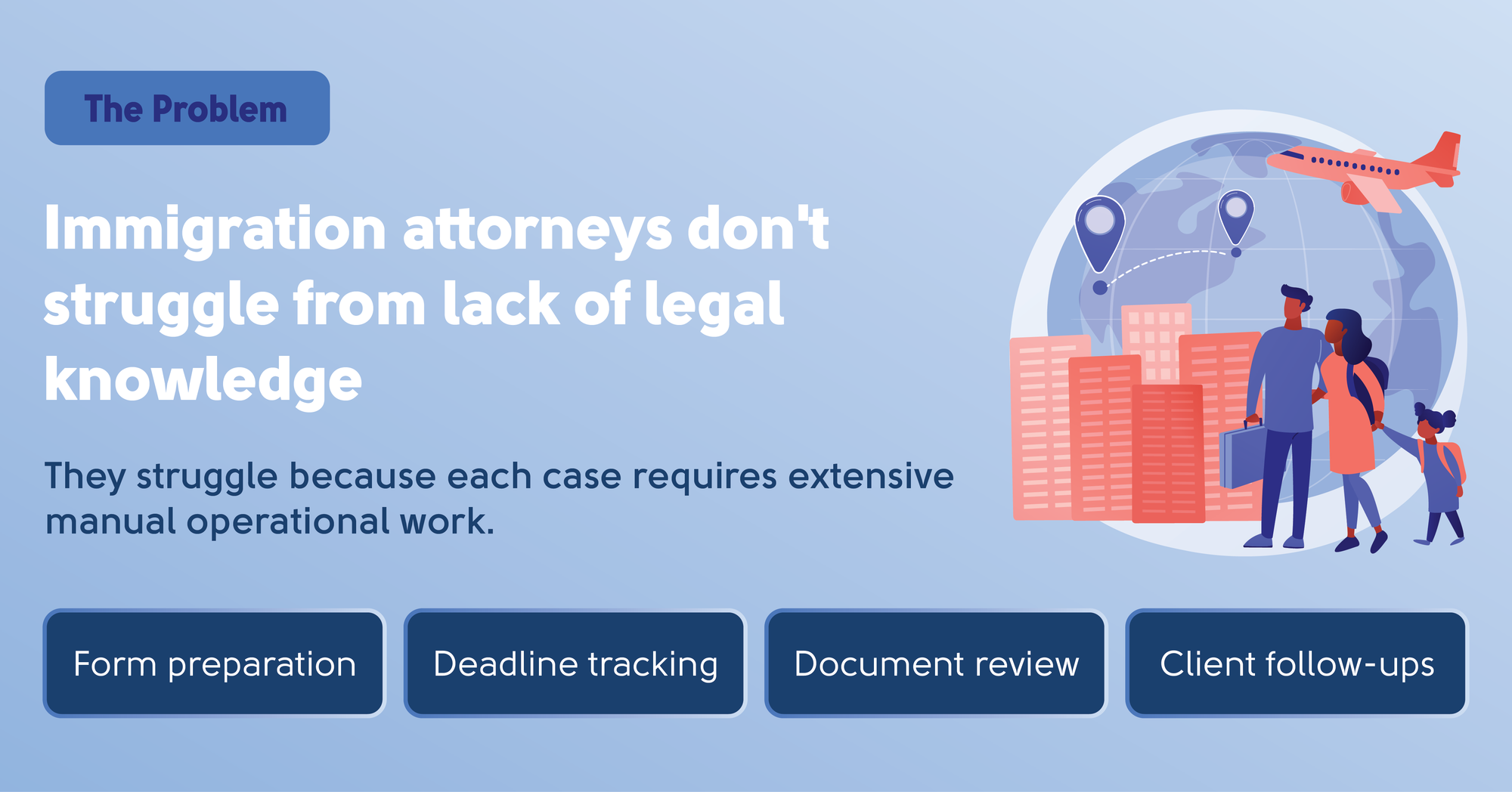
Immigration attorneys do not struggle because they lack legal knowledge. They struggle because the volume of operational work surrounding each case is enormous, and that work still requires human execution.
Forms need to be prepared. Documents need to be reviewed and organized. Deadlines need to be tracked. Filing packets need to be assembled and shipped. Clients need to be followed up with for missing information. Receipt notices need to be matched to cases. Status updates need to go out.
None of this is legal work in the strict sense. But all of it has to happen, accurately and on time, for legal work to reach its conclusion. And in a growing immigration practice, this operational layer is often the binding constraint on how many cases the firm can handle.
Software helps. Automation helps. But software does not prepare a form. It does not follow up with a client who has not responded in two weeks. It does not coordinate the shipping of a filing packet or catch a missing document before it causes a rejection. At some point, there is a person on the other end of these tasks. The question is who that person is, how they are managed, and whether they are actually integrated into your practice or just loosely connected to it.
What Managed Paralegal Support Is Not
It helps to start with what the phrase often does not mean, because the gap between marketing language and operational reality is wide in this space.
It is not a staffing agency. Some platforms position their paralegal offering as a way to find contractors you can hire. They connect you with candidates, facilitate introductions, and then step back. You are responsible for vetting, onboarding, managing, and eventually replacing those people if things do not work out. The platform is not involved in the day-to-day execution. You have added a hiring function to your practice, not removed an operational burden.
It is not a freelance marketplace. Similar to the above, some "managed" offerings are essentially talent pools where attorneys post work and paralegals pick it up. The work may get done, but there is no structured accountability, no visibility into what has happened on a case, and no continuity when a particular freelancer is unavailable.
It is not offshore outsourcing with a login. Some firms have experimented with offshore paralegal teams given access to their case management system. This can work, but the coordination overhead is significant: different time zones, inconsistent quality standards, limited accountability, and no clear ownership when something falls through. Giving someone access to a platform is not the same as that person operating within a managed system.
It is not a chatbot or AI assistant rebranded as a paralegal. This one is increasingly relevant as AI capabilities expand. Automated document population and AI-generated drafts are genuinely useful, but they are technology features, not paralegal support. An attorney still needs to review every output. Calling automation "paralegal support" conflates two different things with different accountability structures.
What Managed Paralegal Support Actually Means
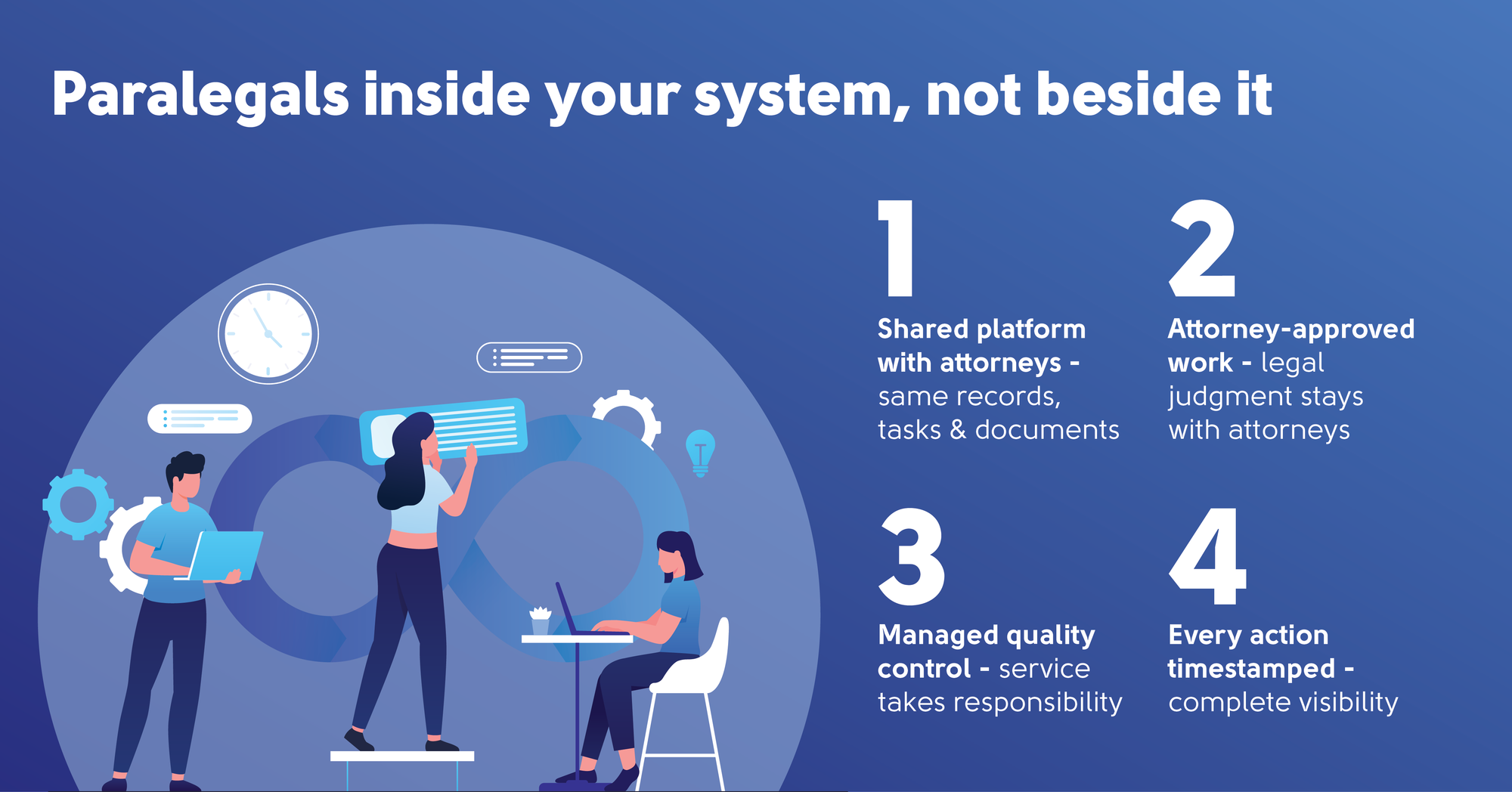
Done properly, managed paralegal support looks like this:
Trained paralegals with immigration-specific knowledge work directly inside your case management platform. They do not operate in a separate system that feeds data back through an integration. They do not email you updates from an external inbox. They work in the same environment your attorneys and internal team use, with full access to the case record, task assignments, documents, and deadlines.
Their work is logged, tracked, and reviewable. When a paralegal prepares a form, updates a case status, or assembles a filing packet, that action is recorded in the system with a timestamp and owner. Your attorneys can see exactly what has been done, what is in progress, and what is pending, without having to ask anyone.
Scope and ownership are clear. Each task has an assigned owner and a defined timeline. Nothing moves forward ambiguously. When a paralegal hands something back to your legal team for review, that handoff is structured, not informal.
Quality and capacity are actively managed. The firm providing the paralegals is responsible for maintaining quality standards across the work, managing capacity as your caseload fluctuates, and handling the operational side of the relationship. You are not managing a contractor. You are working with a service that takes responsibility for outcomes.
Nothing moves without attorney approval. Managed paralegals handle execution. Legal judgment stays with the attorney. Every document, every filing, every submission that requires professional responsibility is reviewed and approved by the attorney before it goes anywhere.
This is what Toorey means by managed paralegal support. Paralegals are not an add-on or a referral. They are trained specifically for immigration work, they operate inside Toorey as the system of record, and the entire relationship is structured so attorneys retain full control and visibility while the operational execution happens reliably around them.
What Toorey Paralegals Actually Do
The specific scope matters as much as the structure. Here is what Toorey's paralegals support in practice:
Case preparation. Immigration form preparation across case types, document checklist management, and initial data entry and validation. Getting a case ready to move forward is time-consuming and detail-sensitive. This is one of the highest-value areas for paralegal support because errors here create downstream problems.
Document and filing support. Letter drafting using approved templates, assembly of filing packets, and coordination of shipping and online submissions. The logistics of getting a complete, accurate filing out the door involve multiple steps and coordination points. Paralegals own this execution end to end.
Case tracking and follow-ups. Status tracking and updates through Toorey, receipt notice and response tracking, and internal reminders and deadline monitoring. Cases do not move forward on their own. Someone has to actively track where each case stands and what needs to happen next. This is exactly the kind of continuous, systematic work that paralegals handle well when they are integrated into a proper case management system.
Client coordination support. Information requests via structured workflows, document follow-ups, and clean handoffs back to the legal team. Getting the right documents from clients at the right time is one of the most persistent operational challenges in immigration practice.
Structured follow-ups, managed through the platform, remove this from the attorney's plate without letting it slip.
All of this work is logged, tracked, and reviewable inside Toorey. Attorneys see everything. Nothing is happening in a black box.
The Real Value: What Changes for Your Practice
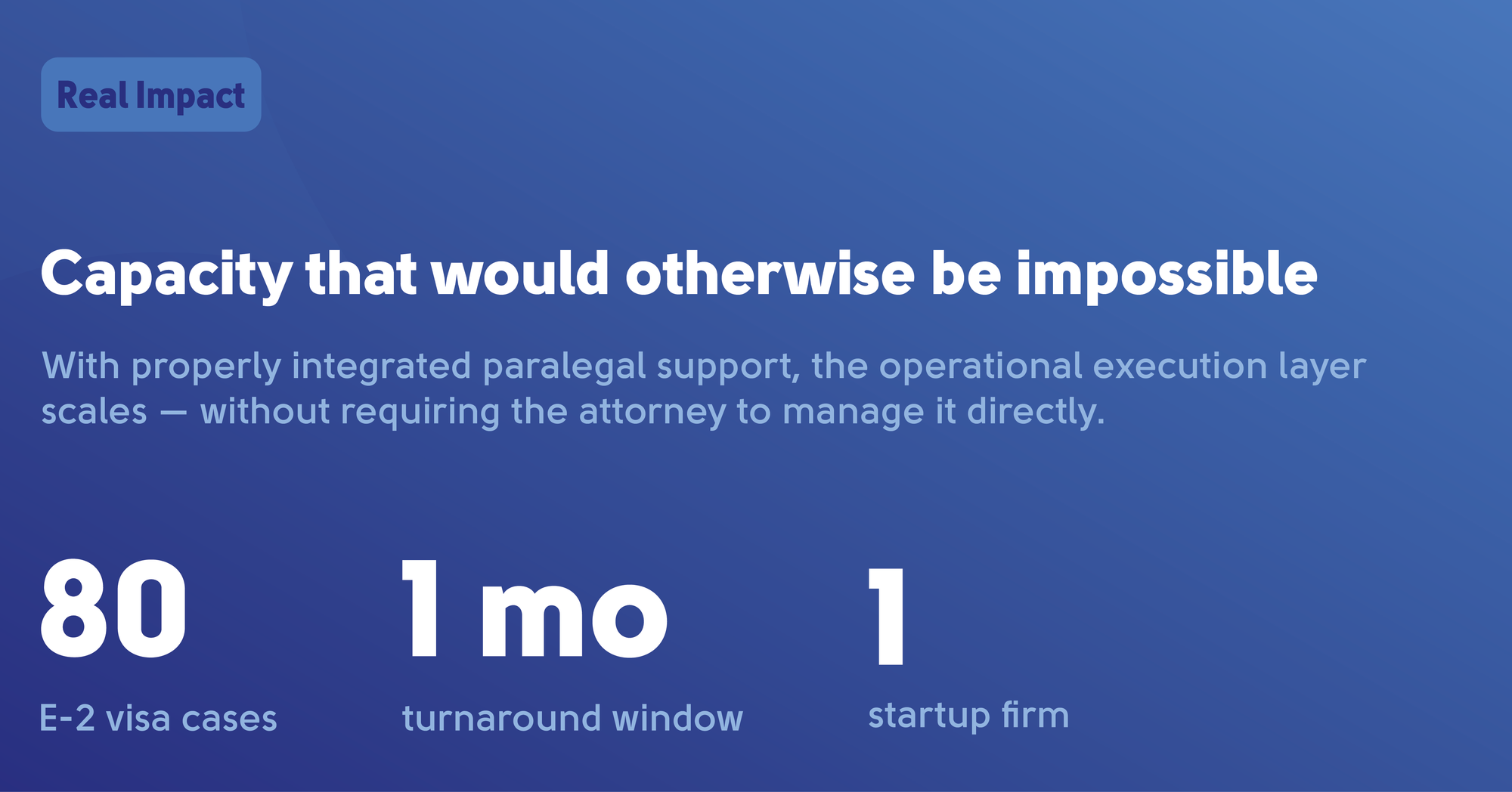
The point of managed paralegal support is not just that tasks get done. It is that the constraint on your practice's capacity shifts.
Without structured operational support, the ceiling on how many cases an immigration firm can handle is set largely by the operational bandwidth of the attorney and whatever internal support staff exist. More cases means more coordination overhead, which at some point means more hiring, which means more management, which takes the attorney further from the legal work.
With properly integrated paralegal support, the operational execution layer scales without requiring the attorney to manage it directly. An attorney at a firm using Toorey's managed paralegals reported being able to handle 80 E-2 visa cases for a Korean conglomerate client within a one-month turnaround, a volume that would have been operationally impossible for a startup firm without this kind of support.
That is not a feature. That is a structural change in what the practice can do.
Questions to Ask Before Committing
If you are evaluating a platform that offers managed paralegal support, these questions will quickly separate real integration from marketing language:
Where do the paralegals actually work? If the answer is anything other than "inside your case management system," the integration is looser than the marketing suggests.
Who manages the paralegals' quality and capacity? If the answer is "you do," you have a staffing relationship, not a managed service.
What does the attorney review step look like? It should be specific, structured, and non-optional. Vague answers here are a signal.
What happens if a paralegal makes an error? A managed service takes responsibility. A contractor arrangement puts it back on you.
Can I see exactly what a paralegal has done on a case at any point? If there is not a clear audit trail inside the platform, transparency is limited.
Is there a minimum commitment or ramp-up period? Understanding the operational onboarding process tells you a lot about how seriously the service is structured.
Why Integration Is the Whole Point
The thing that separates genuine managed paralegal support from everything else is not the quality of the individual paralegals. It is the integration between the people and the system.
When paralegals work inside the same platform as the attorneys, using the same case records, task structures, and communication tools, the overhead of coordination drops dramatically. There are no handoffs across systems. No version control issues with documents. No status updates that require someone to send an email to find out what happened. Everything is in one place, visible to everyone who needs to see it, with clear ownership at every step.
Toorey is built around this principle. The platform and the paralegals are designed to work as one system, not as separate offerings that happen to be sold together. That is what makes the capacity gains real and sustainable rather than marginal and fragile.
Conclusion: Clarity Before Commitment
Managed paralegal support is a meaningful capability when it is real. It changes what an immigration firm can handle, how consistently it can handle it, and how much of the attorney's time goes toward legal work versus operational coordination.
But the phrase is used loosely enough that firms evaluating this kind of service should go in with specific questions, not just a feature checklist. The structure of the relationship, the integration with the platform, the accountability model, and the attorney review process are what determine whether this actually works in practice.
When it is built the right way, as Toorey has built it, managed paralegal support is not a staffing solution. It is an operational model that lets immigration attorneys practice at a higher level.
See how Toorey's managed paralegal support works in practice. Book a demo at toorey.com.