How Immigration Firms Keep Cases Moving When Paralegals Are Unavailable
Picture this. It is the third week of March. H-1B cap season is in full swing. You have forty active petitions in various stages of preparation. Your lead paralegal, the one who knows every one of those cases, who has been managing client follow-ups, tracking receipt notices, and coordinating employer documentation for the past three months, calls in sick on Monday.
She is out Tuesday too. By Wednesday it is clear she will be gone for the rest of the week.
You open the case management system, or the shared drive, or the spreadsheet, or whatever combination of tools your firm uses, and you realize something uncomfortable: you are not entirely sure where half of these cases stand. Some documents are in her inbox. Some follow-ups exist only in her memory. A few deadlines are tracked in a spreadsheet she maintains that nobody else fully understands.
This scenario is not unusual. It plays out at immigration firms of every size, every year, with different triggers: illness, family leave, unexpected resignation, a paralegal who is simply buried under a volume spike and starting to drop things. The details change. The underlying problem does not.
The paralegal who knows everything about your cases is not an asset. She is a single point of failure.
How Single Points of Failure Form
Single points of failure in immigration case operations do not usually happen by design. They form gradually, through a series of reasonable decisions that accumulate into a fragile structure.
A paralegal joins the firm and turns out to be excellent. She is reliable, detail-oriented, and takes ownership of her cases in a way that makes the attorneys' lives easier. Over time, she becomes the person who handles everything for certain clients. Attorneys stop needing to check in because they trust her. Clients start emailing her directly. Other staff route questions her way because she always knows the answer.
This feels like a success. The firm has a great paralegal and things are running smoothly. What it has actually built is a structure where one person's absence stops things from running at all.
The knowledge about case status, document locations, client communication history, pending follow-ups, and upcoming deadlines has migrated out of any shared system and into one person's head, inbox, and personal workflow. The firm did not intend this. It is simply what happens when excellent individual performance substitutes for good operational systems.
What Actually Breaks When That Person Is Gone
The disruption is never just the tasks themselves. It is the invisible knowledge that makes the tasks executable.
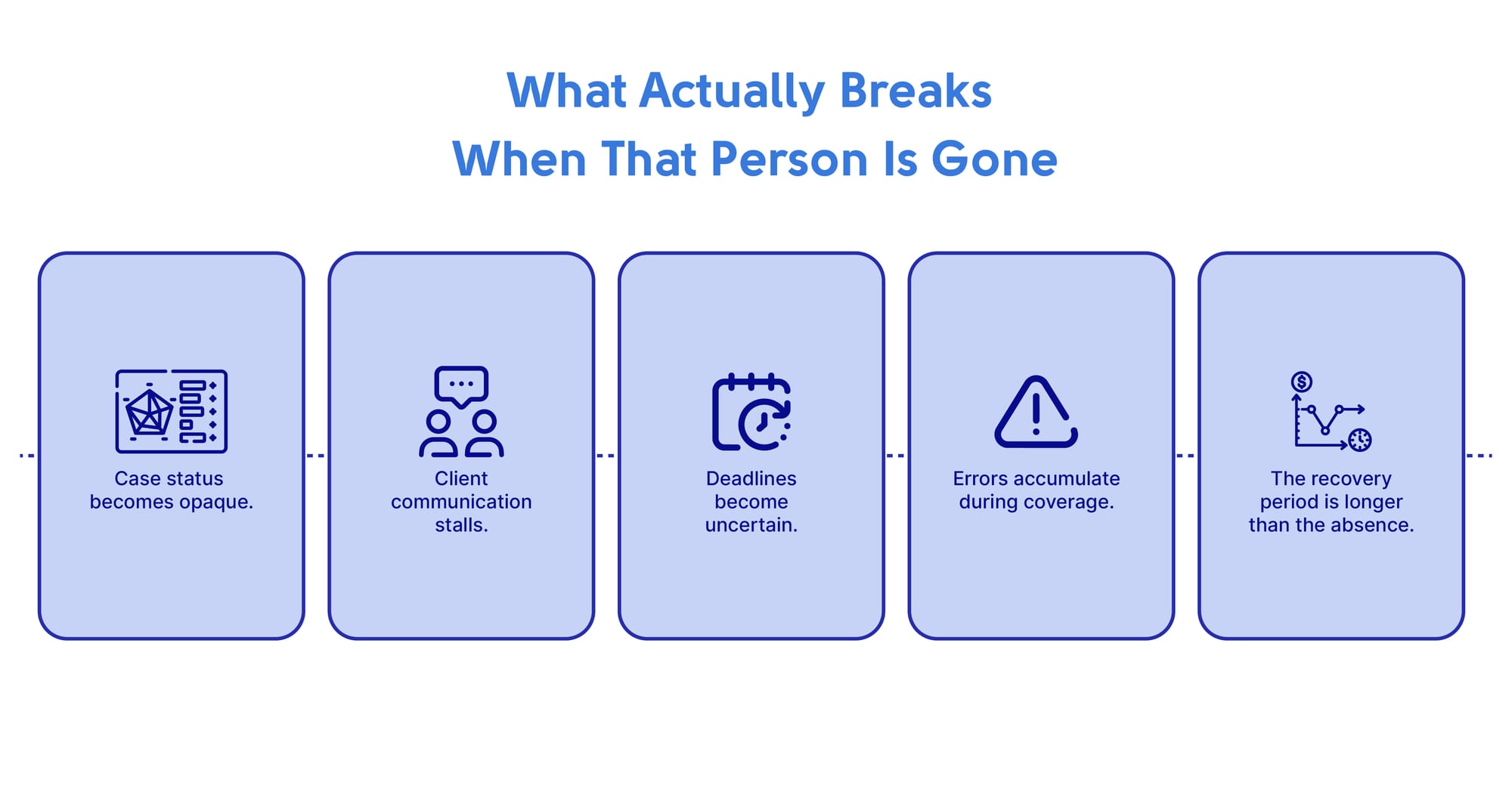
Case status becomes opaque. Without a centralized, up-to-date record of where each case stands, attorneys have to reconstruct status from scattered sources: emails, filing receipts, client messages, notes in a shared drive that may or may not reflect the current reality. This takes time the firm does not have during a filing crunch.
Client communication stalls. Clients expect updates. When the person who handles their matter is suddenly unavailable, and no one else has the context to step in seamlessly, updates slow down or stop. Clients notice. Some of them start calling. Some of them start worrying. In corporate immigration, where HR teams are tracking visa timelines for employee relocations, unexplained silence from the firm creates real operational problems for the client's business.
Deadlines become uncertain. A paralegal who tracks deadlines in her own system or her own inbox is the only person who fully knows what is coming due and when. When she is out, other staff have to guess, reconstruct, or escalate to attorneys who then have to spend time on operational triage rather than legal work.
Errors accumulate during coverage. When a colleague steps in to cover, they are doing so without full context. They do not know the client preferences, the case history, or the specific documentation standards for that matter. The error rate during these coverage periods is meaningfully higher than normal. In immigration law, where a single missing document or incorrectly completed form can trigger an RFE or cause a rejection, those errors have real consequences.
The recovery period is longer than the absence. Even after the paralegal returns, there is a period of catching up, correcting things that went sideways during the absence, and reassuring clients who felt the disruption. A one-week illness can generate two to three weeks of residual cleanup.
The Overwhelm Version Is Quieter and More Dangerous
Illness and leave are visible disruptions. You know something is wrong and you respond. The overwhelm version is more insidious because it does not announce itself.
An immigration paralegal who is carrying more cases than she can handle does not suddenly stop working. She prioritizes. She makes judgment calls about what can wait. She handles the loudest problems first and lets quieter ones drift. She means to follow up on that document request from three weeks ago but keeps not getting to it. She knows a deadline is coming and intends to start the preparation but has not had a clear window.
This is not negligence. It is a normal human response to being given more work than one person can execute well. But from the firm's perspective, the effect is the same as a partial absence: cases that should be moving are stalling, follow-ups are slipping, and the attorneys are not always aware of it because the paralegal is still at her desk and still responding to messages.
The difference is that the overwhelm version often does not surface until something actually breaks. A deadline is missed. A client calls to ask why they have not heard anything in three weeks. An RFE arrives that could have been anticipated and prepared for but was not because the case was not being actively tracked.
By the time the problem is visible, it has already cost the firm.
Why This Is Structural, Not Personal
It is tempting to frame this as a performance issue or a capacity planning issue. Hire better people. Hire more people. Set clearer expectations.
Those things matter, but they do not solve the underlying problem. The underlying problem is that most immigration firms have built their operations around individual knowledge rather than shared systems. The firm's operational intelligence lives in people, not in platforms.
When that is the case, every excellent paralegal is also a liability. The better they are at their job, the more knowledge accumulates with them, and the more disruptive their absence becomes.
The solution is not to find paralegals who are less effective or less trusted. It is to build operations so that the knowledge required to move a case forward lives in the system, not the person.
What Good Case Operations Look Like
In firms that have solved this problem, a few things are consistently true.
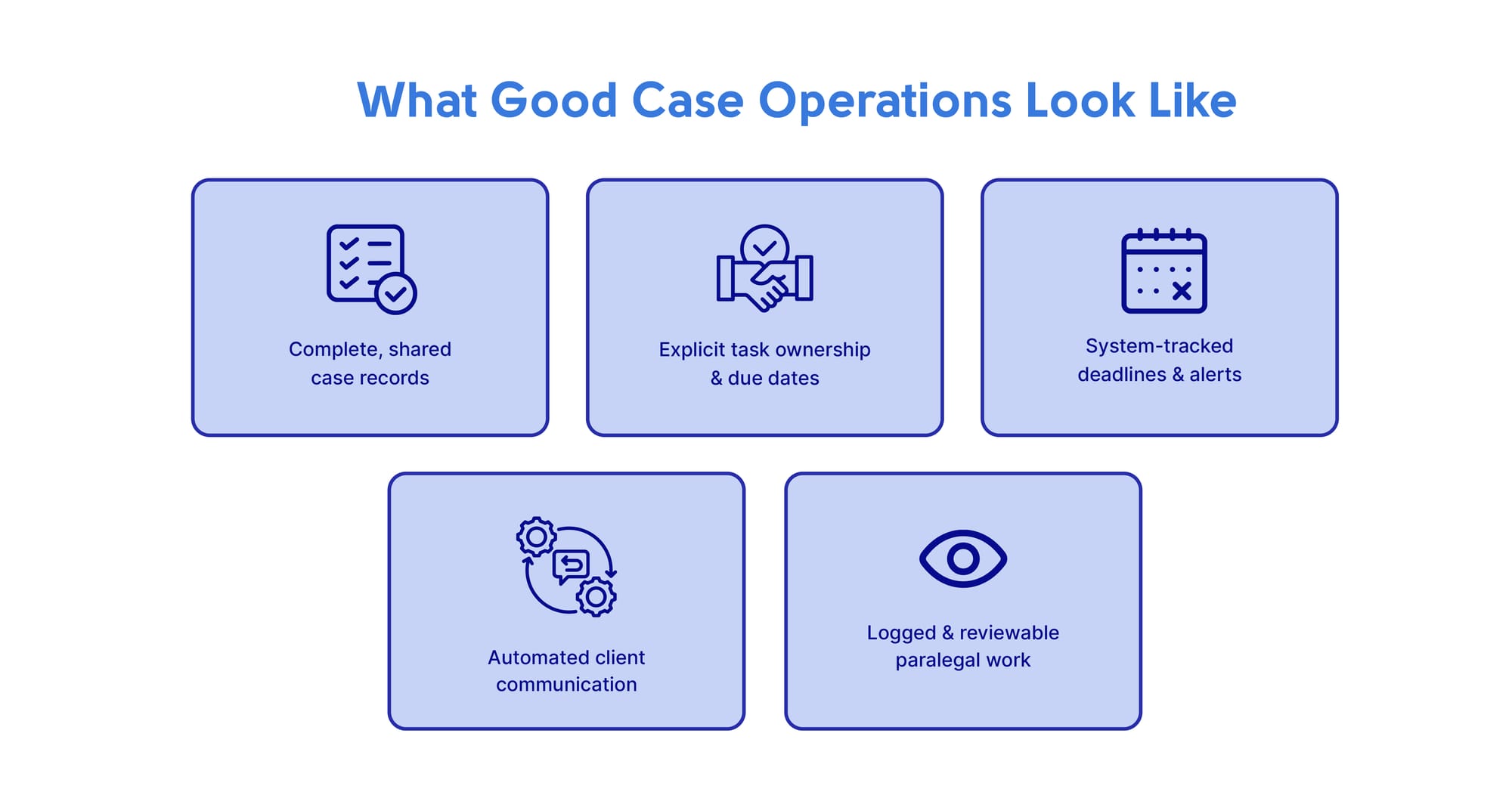
Every case has a complete, current record in a shared system. Not a shared drive with folders. Not a spreadsheet that someone maintains. A structured case management platform where status, documents, tasks, deadlines, and communication history are updated in real time as work happens. When any team member opens a case, they can see exactly where it stands without asking anyone.
Task ownership is explicit and visible. Every open action on a case has an assigned owner and a due date. There is no ambiguity about who is responsible for what. When a paralegal is out, a supervisor or coverage staff can open the system, see every outstanding task, and either reassign or handle them without needing a briefing.
Deadlines are tracked by the system, not the person. USCIS filing windows, RFE response deadlines, internal preparation milestones: all of it is in the platform with automated alerts that escalate as dates approach. No single person is the custodian of deadline awareness.
Client communication is tied to case data. Updates go out based on what has actually happened in the case, not based on a paralegal remembering to send them. When a filing is submitted, the client knows. When a receipt notice comes in, the client knows. The communication layer runs on the system, not on individual follow-through.
Paralegal work is logged and reviewable. When a paralegal prepares a form, follows up with a client, or assembles a filing packet, that action is recorded in the system. Any team member, and any attorney, can see what has been done, when, and by whom. There are no black boxes.
How Toorey Addresses This Directly
Toorey is built around the principle that cases should move forward because of systems, not because of any particular individual being available at any particular time.
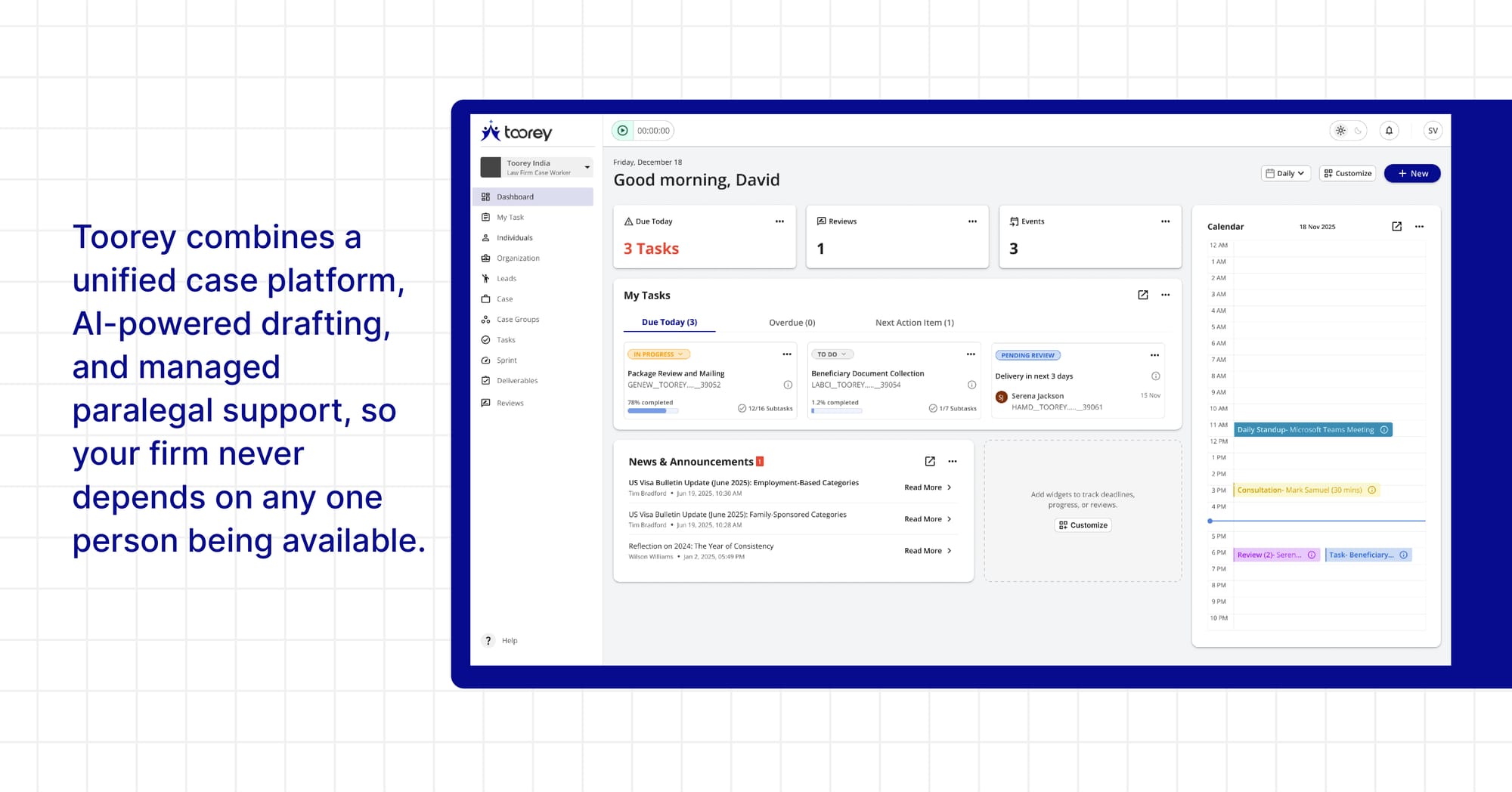
Every case in Toorey has a central workspace where all documents, tasks, deadlines, notices, and communications live together. The case record is always current because work happens inside it, not around it. When a paralegal is out, any other team member can open the case and pick up exactly where things left off without reconstruction or guesswork.
Toorey's managed paralegal support goes a step further. Rather than relying on a single paralegal assigned to a matter, Toorey provides trained immigration paralegals who operate within the platform as a team, with Toorey managing capacity, continuity, and quality. When one paralegal is unavailable, the work does not stop. The case record is complete, the tasks are assigned, and coverage happens without the firm absorbing the disruption.
Deadlines are tracked automatically at the case level, with alerts that surface to attorneys and paralegals based on proximity. No one person is carrying that awareness in their head. The system carries it and surfaces it reliably.
Client updates are tied to live case data rather than to individual follow-through. Clients stay informed because the platform keeps them informed, not because a specific paralegal remembered to send an email.
The result is a firm that does not have single points of failure, not because it has found paralegals who never get sick or overwhelmed, but because the operational structure does not depend on any individual being present and available at all times.
A Question Worth Asking Right Now
Before the next filing crunch, before the next illness or leave or resignation, it is worth asking a straightforward question about your firm's current operations.
If your most important paralegal were out for two weeks starting tomorrow, what would break?
If the honest answer involves real uncertainty about case status, upcoming deadlines, or client communication, that is not a staffing problem. It is a systems problem. And it is one that will keep generating disruption until the underlying structure changes.
The firms that have built around this vulnerability are not operating with better people. They are operating with better systems and, in many cases, with paralegal support models that distribute knowledge and accountability across a platform rather than concentrating it in individuals.
That is a solvable problem. But it has to be recognized as a structural issue before it can be addressed as one.
Toorey's managed paralegal support is built so your cases keep moving regardless of who is available on any given day. See how it works at toorey.com.