How to Choose Immigration Law Firm Software: A Buyer's Guide for U.S. Attorneys

Choosing practice management software is one of the most consequential decisions an immigration law firm can make. The right platform compounds your firm's capacity over time. The wrong one costs you months of disrupted workflows, frustrated staff, and lost productivity.
With dozens of tools now competing for the same market, it can be hard to tell the difference between a platform built for immigration attorneys and a generic legal tool with an immigration label slapped on it. This guide will walk you through exactly what to evaluate, what questions to ask during a demo, and what separates a real solution from a half-measure.
Step 1: Get Clear on What Your Firm Actually Needs
Before you look at a single demo, take stock of where your practice stands today.
The right software for a solo practitioner managing family-based cases looks different from the right software for a 15-attorney firm processing hundreds of H-1B petitions each spring. Start by answering these questions honestly:
How many active cases are you managing? Platforms scale differently. Some are optimized for smaller case volumes with simpler interfaces. Others are built for high-volume, multi-attorney practices with complex workflows. Know your current load and your growth target.
Where are your biggest bottlenecks right now? For most firms, the answer is one of three things: deadline tracking, document management, or billing. Some firms struggle with all three. Knowing your primary pain point helps you weight features appropriately when comparing tools.
How much paralegal support do you have? If you're stretched thin on support staff, a platform that offers managed paralegal operations alongside the software is worth far more than one that just gives you tools to manage paralegals you don't have.
What tools are you already using? Your new platform should connect cleanly with your existing stack: email, billing, document storage. If it doesn't integrate, you've just added another silo.
Step 2: Evaluate Whether the Software Is Actually Built for Immigration
This is the most important filter. A surprising number of "immigration software" products are general legal practice management tools with a thin immigration-specific layer on top. That distinction matters enormously in practice.
True immigration-specific software is built around how immigration cases actually work: visa categories, USCIS form libraries, RFE workflows, priority dates, employer petitions, and the specific compliance requirements that come with handling sensitive immigration status data.
Here's how to test for it during a demo:
Ask to see H-1B and green card workflows out of the box. If the sales rep needs to show you how to build those workflows yourself, that's a signal. A purpose-built platform comes pre-configured for the case types you handle every day.
Ask where USCIS form updates live. Immigration forms change. If the vendor can't clearly explain how form updates are pushed to the platform and how quickly, that's a real operational risk.
Ask how the platform handles RFE responses. This is one of the most document-intensive, deadline-sensitive workflows in immigration law. If there's no dedicated RFE workflow, that's a gap you'll feel every time an RFE lands.
Platforms like Toorey are built from the ground up for immigration, with case types, form libraries, and workflows specific to employment-based and family-based immigration already built in. That's not the same as a generic tool that can be configured to work for immigration if you invest enough setup time.
Step 3: Assess the Core Feature Set
Once you've confirmed the platform is genuinely immigration-focused, evaluate these core capability areas:
Case Management and Visibility
Every case in your firm should have a single source of truth. Documents, deadlines, USCIS notices, communications, and task ownership should all live in one place, visible to everyone who needs access and protected from everyone who doesn't.
Ask: Can I see the status of every active case in one view? Can I tell at a glance which cases have upcoming deadlines this week? Who owns each open task?
Deadline Tracking and Automated Alerts
In immigration law, a missed deadline can be irreversible. Your platform's deadline tracking should be active, not passive. It shouldn't just store dates; it should surface them proactively with escalating reminders as filing windows approach.
Ask: How does the system alert me when a deadline is approaching? Can I set custom internal milestones alongside USCIS deadlines? What happens if a task is overdue?
AI-Powered Drafting
AI drafting tools have moved from novelty to practical necessity for immigration attorneys. The ability to generate a first draft of an H-1B support letter, cover letter, or RFE response in minutes rather than hours has a measurable impact on how many cases a firm can handle.
The key question is not just whether the platform has AI drafting, but how it handles the attorney review step. A strong platform uses an "AI drafts, attorney approves" model, where the technology handles the time-consuming first pass and the attorney maintains full control over every final document.
Toorey's AI drafting works this way, flagging risks and surfacing case analysis alongside the draft so the reviewing attorney has everything they need to make a confident final call.
Integrated Paralegal Support
Software alone does not solve a capacity problem. If your firm is limited by paralegal bandwidth, the most powerful case management platform still leaves you stretched thin.
Some platforms, Toorey among them, address this directly by supplying trained paralegals as part of the service, operating within the platform to manage filings, follow-ups, and notices. For firms that need to scale case volume without adding full-time staff, this is a significant differentiator.
Ask: Does the platform offer any staffing support, or is it software only?
Billing and Payment Integration
Case management and billing should be connected. When time entries, invoices, and payment records are siloed from case activity, attorneys under-bill, invoices get delayed, and cash flow suffers.
Look for platforms that integrate with tools like QuickBooks and Stripe, where billing flows naturally from case milestones, and outstanding balances are visible without logging into a separate system.
Security and Compliance
Immigration case data is among the most sensitive a law firm handles. Your platform must meet the data protection standards your clients and regulators expect.
At a minimum, look for SOC 2 Type II certification, encryption at rest and in transit, granular permission controls, and a full audit trail. Toorey holds SOC 2 Type II and ISO 27001 certifications and is GDPR compliant, with AES-256 encryption and TLS 1.3 protecting all data.
Step 4: Ask the Right Questions in the Demo
A polished demo can make almost any platform look good. The questions below are designed to get past the highlight reel.
"Can you show me what happens when an RFE comes in on a case that's already active?"
Ans: This tests the real workflow, not a staged one.
"How long does onboarding typically take, and what does it involve?"
Ans: A platform with a 3-4 week onboarding requirement is a meaningful operational disruption. A well-designed platform should be up and running in days, not months.
"What integrations do you support natively, and which require a third-party connector like Zapier?"
Ans: Native integrations are more reliable and require no additional subscriptions or setup.
"What does your customer support look like after onboarding?"
Ans: Responsive, knowledgeable support from people who understand immigration law is meaningfully different from a generic help desk.
"How do form updates get pushed when USCIS changes a form?"
Ans: This should have a clear, specific answer, not a vague assurance.
Step 5: Think About Total Cost, Not Just Price Per Seat
Immigration software is typically priced per user per month, with some platforms adding per-case fees on top. Per-case fees can compound quickly at high case volumes, so model out your actual projected cost before comparing headline prices.
More importantly, factor in the cost of what the platform replaces. A platform that eliminates the need for a standalone billing tool, a document management system, and a separate time-tracking app may cost more per seat than a cheaper alternative but save money overall.
And factor in the cost of not switching. If your current setup is costing attorneys two to three hours per case in administrative overhead, that is a real, quantifiable revenue impact. The right platform pays for itself quickly.
What the Best Immigration Software Has in Common
After working through the evaluation criteria above, a few patterns emerge among platforms that consistently serve immigration firms well.
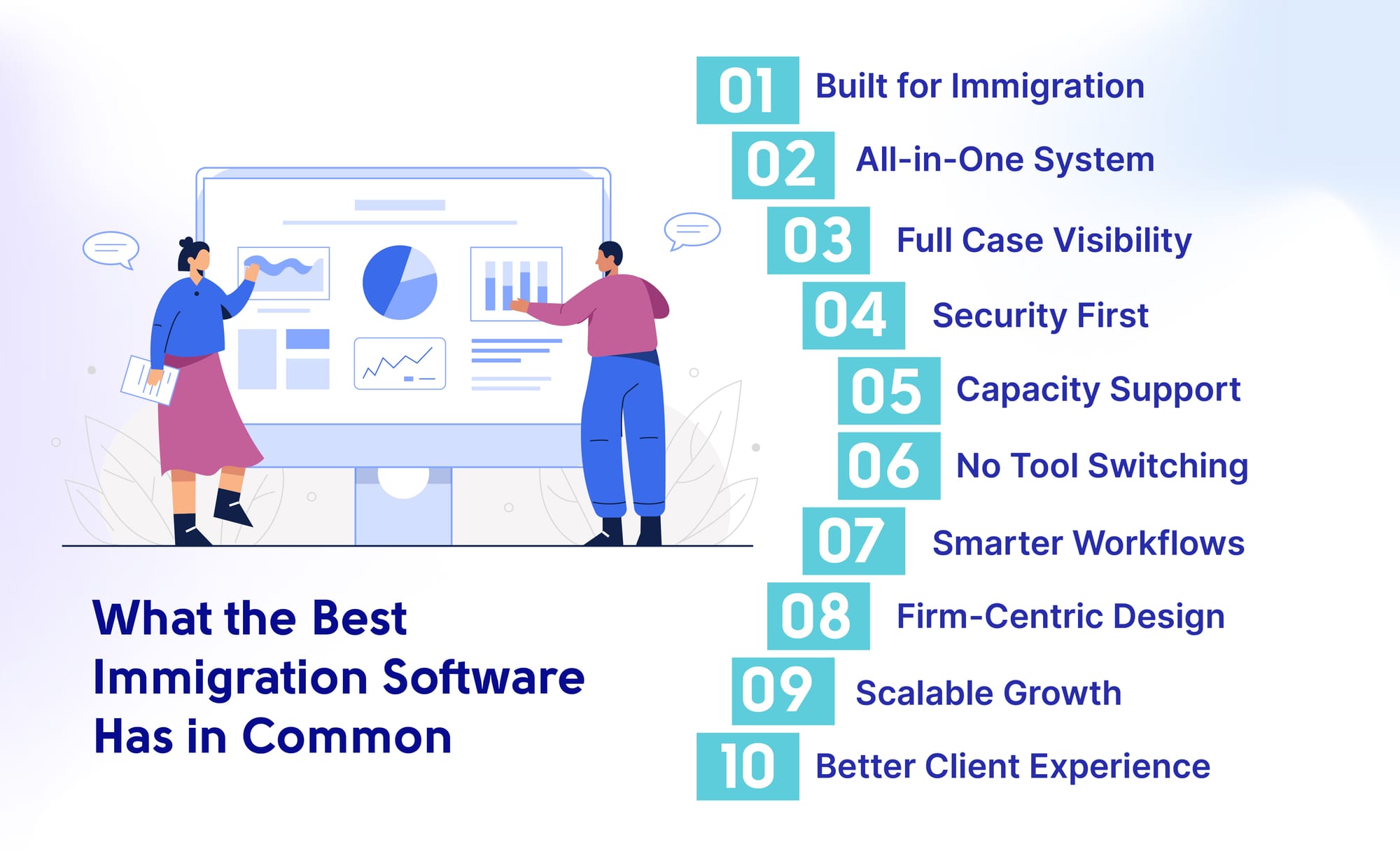
- They are purpose-built for immigration, not adapted from generic legal tools.
- They unify case management, billing, communications, and compliance in a single environment rather than stitching together separate products.
- They give attorneys clear visibility across all active cases without requiring manual reporting. They take security and compliance seriously at the infrastructure level, not just as a checkbox. And they think about the firm's capacity problem holistically, which in some cases means supplying paralegal support alongside the technology.
Toorey was built with all of this in mind:
It is an all-in-one platform designed specifically for U.S. immigration law firms, combining AI-powered drafting, managed paralegal operations, end-to-end case management, and enterprise-grade compliance in one connected system.
Conclusion: Take Your Time, Ask Hard Questions
Switching practice management software is not trivial. It disrupts workflows, requires staff retraining, and takes time to deliver its full value. That's exactly why the evaluation process matters.
Go in with a clear picture of your firm's needs, test the platform against real immigration workflows rather than staged demos, and think about total value rather than just the monthly price.
The firms that get this decision right tend to see measurable results quickly: faster case turnaround, fewer filing errors, more capacity, and a cleaner path to growth.