The Hidden Cost of Paralegal Turnover at Immigration Firms
When a paralegal leaves an immigration firm, the immediate response is usually the same: post the job, cover the workload internally while the search runs, hire someone new, and spend the next few weeks getting them up to speed. It feels like a manageable disruption. A few weeks of friction, then back to normal.
That framing significantly underestimates what is actually happening.
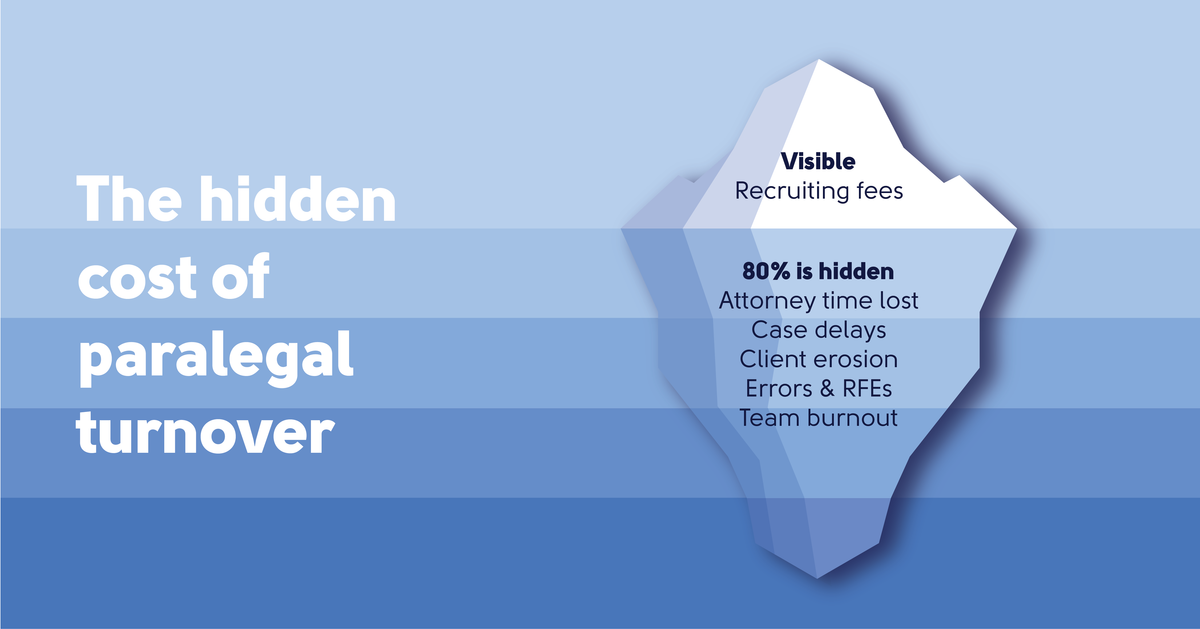
Paralegal turnover at immigration firms is one of the most expensive operational problems in the practice, and most of the cost is invisible on a profit and loss statement. It does not show up as a line item. It shows up as slower case turnaround, more attorney hours spent on coordination, errors that trickle through during transition periods, client relationships that fray quietly, and a firm culture that starts to feel perpetually unstable.
This piece breaks down where the real cost lives, why immigration firms are particularly exposed to it, and what the firms managing it best are doing differently.
Why Immigration Firms Are Especially Vulnerable
Paralegal turnover is a challenge across legal practice areas, but immigration firms feel it more acutely than most for a specific reason: the work is highly specialized and the institutional knowledge required to do it well takes a long time to build.
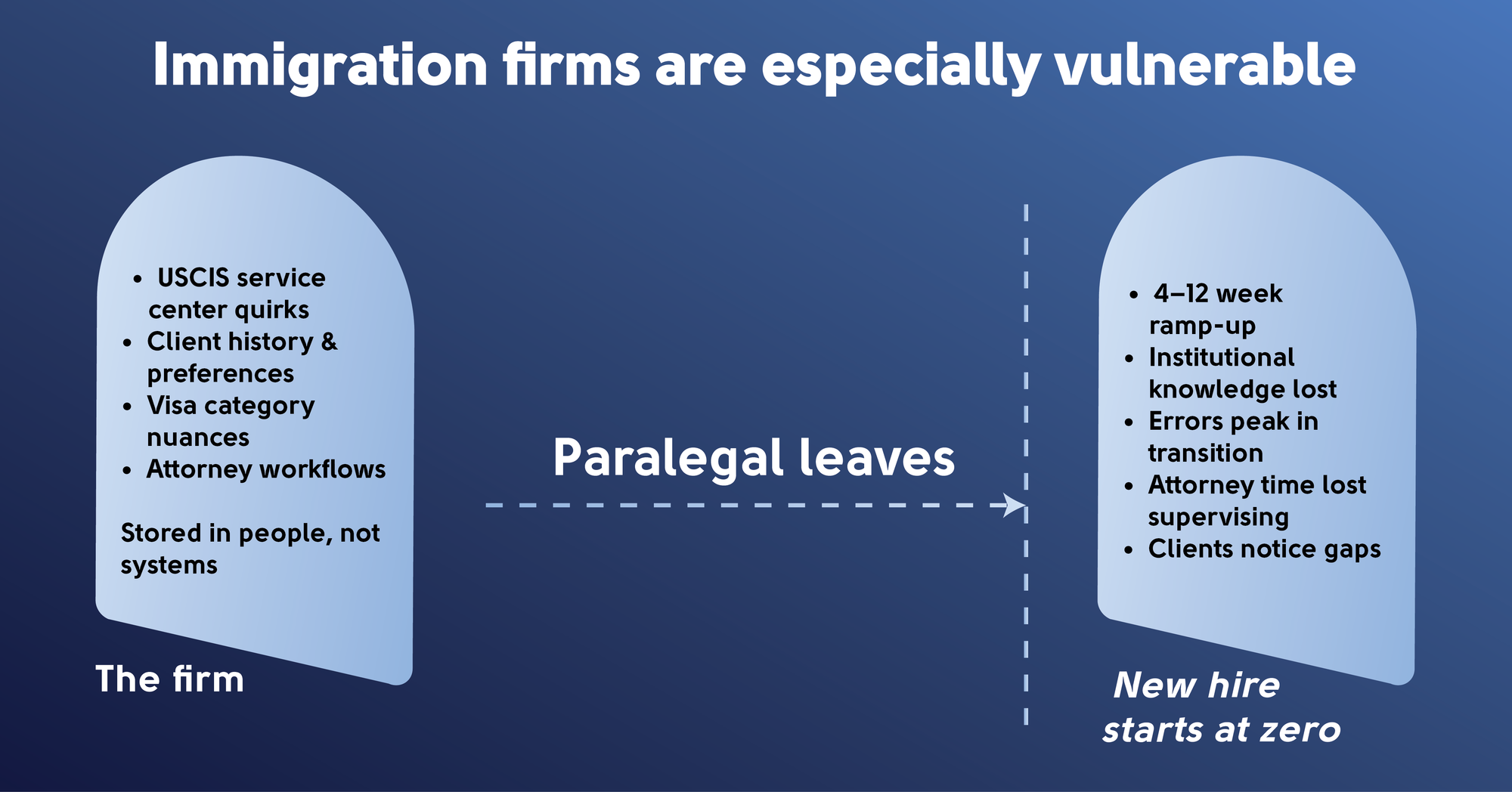
An immigration paralegal at a functional firm is not just filling in forms. They know the nuances of specific visa categories, the quirks of particular USCIS service centers, the documentation preferences of specific attorneys, and the history of long-running client matters. They know which clients need more hand-holding and which can be trusted to submit documents on time. They know the shortcuts that are safe and the ones that are not.
That knowledge is not written down anywhere. It lives in the paralegal's head, built up over months of working in a specific practice with specific attorneys and specific clients. When they leave, it walks out with them.
A new hire, regardless of their general immigration paralegal experience, starts from zero on all of that institutional context. The ramp-up period before they are fully productive is longer than most firms budget for.
The Real Numbers Behind a Single Departure
The commonly cited cost of replacing an employee is somewhere between 50 and 200 percent of their annual salary, depending on the role and the industry. For a specialized paralegal role at an immigration firm, the realistic number sits toward the higher end of that range.
Breaking it down makes clear why.
Recruiting costs. Job postings, recruiter fees if you use one, and the time spent by firm leadership or office management screening resumes and conducting interviews all carry real costs. A thorough search for a qualified immigration paralegal typically takes four to eight weeks. During that time, someone at the firm is absorbing the search work on top of their regular responsibilities.
Coverage costs during the gap. While the role is open, the work still exists. Attorneys pick up tasks that are below their billing rate. Other paralegals stretch to cover, which creates its own burnout and attrition risk. Some work gets delayed. Cases that should move forward in a week take two or three. At scale, across a caseload of dozens of active matters, that delay has a compounding effect on throughput and client satisfaction.
Onboarding and training costs. Once someone is hired, they are not productive immediately. A new immigration paralegal typically needs four to twelve weeks to reach full working capacity at a new firm, depending on their prior experience and the complexity of the firm's workflows. During that period, attorneys spend time supervising, correcting, and answering questions that an experienced paralegal would not need to ask. That supervision time is billable time not billed.
Error costs during the transition. This is the one that rarely gets quantified but can be the most damaging. The period immediately after a departure and during a new hire's ramp-up is when mistakes are most likely. A document submitted with incorrect information. A deadline that falls through the gap between the outgoing and incoming paralegal. An RFE response assembled incorrectly because the new hire did not yet know the firm's standards. Each of these errors carries its own cost: attorney time to fix it, potential USCIS fees, and in serious cases, client relationships that do not recover.
Client relationship costs. Immigration clients, particularly corporate clients managing employee visa programs, pay close attention to consistency and reliability. When they notice case updates slow down, when their calls go to someone new who does not know their history, when small errors start appearing that did not appear before, they start asking questions. Some of them start looking at other firms. The cost of a client relationship that erodes over a turnover event is hard to quantify but very real.
The Compounding Problem: Turnover Breeds Turnover
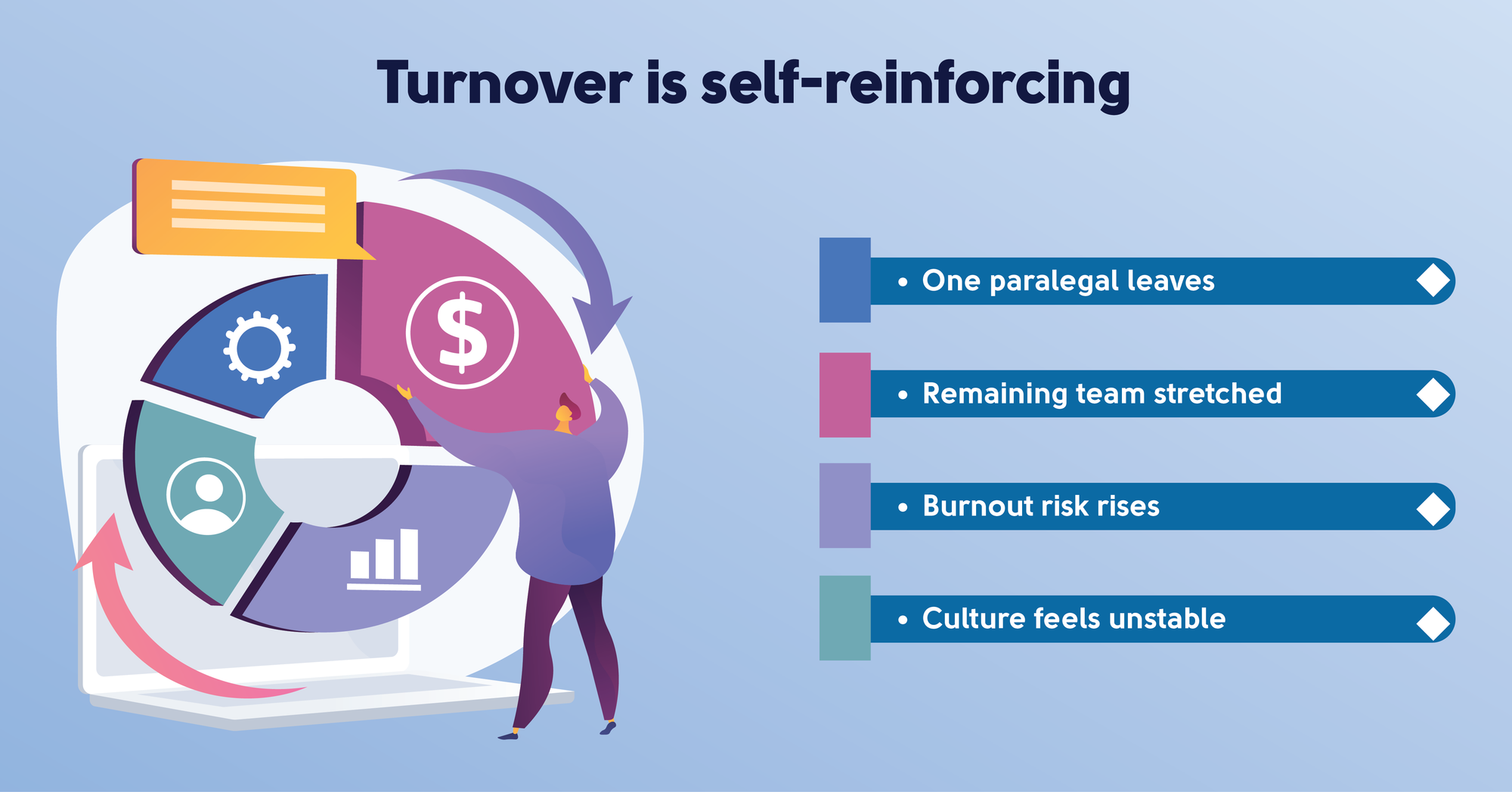
One of the most underappreciated dynamics of paralegal turnover is that it is self-reinforcing. A single departure does not just cost the firm once. It creates conditions that make the next departure more likely.
When a paralegal leaves, the remaining staff absorb their workload while the position is open. That added pressure increases stress and burnout risk for the people still there. If the replacement hire takes longer than expected to reach full productivity, the pressure extends. If the firm has been through multiple departures in a short period, the culture starts to feel unstable, which makes it harder to attract strong candidates and easier for those who do join to conclude that the grass is greener elsewhere.
High-volume immigration practices with inconsistent paralegal staffing often find themselves caught in a cycle where turnover generates conditions that produce more turnover. Breaking out of that cycle requires addressing the root cause rather than just filling positions faster.
What Drives Paralegal Turnover at Immigration Firms
Understanding the cost is only useful if you understand the cause. The factors that drive paralegal turnover at immigration firms tend to cluster around a few consistent themes.
Operational chaos. Paralegals who work in disorganized environments, where cases are tracked across spreadsheets, documents are scattered across email threads, and priorities shift without clear communication, burn out faster than those in structured operations. The work of immigration paralegal practice is already demanding. Layering operational chaos on top of it makes the role feel untenable.
Limited tools. Paralegals who spend large portions of their day on tasks that could be automated, manual data entry, reformatting documents, sending routine follow-up emails, feel underutilized and undervalued. The best paralegals, the ones firms most want to retain, are often the ones most frustrated by inefficient tools.
Unclear scope and ownership. When it is never quite clear whose job a particular task is, or when paralegals are constantly context-switching between unrelated responsibilities because the workload is disorganized, it is hard to feel effective. A lack of clarity about role and scope is a consistent driver of dissatisfaction.
Compensation pressure. Immigration paralegal salaries have risen significantly as demand has outpaced supply. Firms that have not kept pace with market rates are increasingly vulnerable to losing experienced staff to competitors or to corporate in-house teams.
Lack of career trajectory. Paralegals who do not see a clear path forward at a firm, whether toward more senior paralegal roles, operations management, or other advancement, tend to look elsewhere after a few years.
How the Best Firms Are Structuring Around It
The immigration firms that have the most stable paralegal operations tend to share a few common approaches.
They use systems that reduce dependence on individual knowledge. When case status, documents, task ownership, and deadlines all live in a structured platform rather than in someone's head or inbox, a departure does not take the institutional knowledge with it. The new hire can open the system and see exactly where every case stands. The knowledge is in the platform, not the person.
They reduce the volume of low-value work. Firms that have automated the most repetitive paralegal tasks, form population, routine reminders, status updates, standard follow-ups, find that their paralegals spend more time on work that actually requires judgment. That makes the role more satisfying and reduces the burnout-driven turnover that comes from spending all day on mechanical tasks.
They treat operational stability as a retention tool. A well-structured operation is easier to work in. Paralegals who can come in, see clearly what needs to be done, do it with good tools, and hand off cleanly at the end of the day are more likely to stay than those navigating constant ambiguity.
Some firms have moved to managed paralegal models. Rather than employing paralegals directly and absorbing the full cost and risk of turnover, a growing number of immigration firms are working with managed paralegal services where the operational relationship is handled externally. The firm gets consistent, trained paralegal support without taking on the hiring, training, management, and replacement burden. When a paralegal transitions off a case, the service manages that continuity, not the attorney.
This is one of the core reasons firms use Toorey's managed paralegal support. The paralegals work inside Toorey as the system of record, meaning every case action is logged and visible regardless of who is handling it at any given time. When capacity changes, Toorey manages it. The firm does not absorb a disruption every time there is a staffing change on the operations side.
The Stability Equation
The firms that grow most sustainably in immigration practice are not necessarily the ones with the most attorneys or the biggest marketing budgets. They are the ones that have built operational foundations stable enough to handle volume without constant disruption.
Paralegal turnover is one of the biggest threats to that stability. It is expensive, it is self-reinforcing, and most of the cost is invisible until it has already done its damage.
The response is not just to hire faster or pay more, though both matter. It is to build a practice where the operational layer does not depend on any individual person staying, where knowledge lives in systems rather than in staff, and where the work environment itself is structured enough to retain the people you want to keep.
That is a harder problem than a job posting solves. But it is the problem worth solving.
Toorey's managed paralegal support is built to give immigration firms consistent, system-integrated execution without the turnover risk. See how it works at toorey.com.