RFE Response Management: How Immigration Firms Handle Requests for Evidence Without Losing Time

A Request for Evidence is one of the most operationally demanding things that can happen to an immigration case. It arrives without much warning. It comes with a hard response deadline, typically 84 or 87 days, and be ranging from 30 to 120 days, that cannot be extended in most circumstances. It requires gathering documentation, drafting a legal argument, assembling a response package, and filing it correctly, all while the rest of the caseload continues moving.
For an immigration firm handling one or two RFEs at a time, the process is demanding but manageable. For a firm handling employment-based immigration at volume in 2026, RFEs are arriving frequently enough that managing them efficiently is not optional. It is a core operational competency.
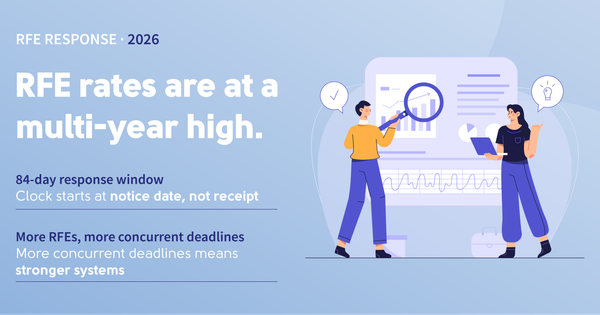
USCIS RFE issuance rates have risen significantly under the current administration, particularly for H-1B specialty occupation determinations, O-1 extraordinary ability petitions, and EB-2 National Interest Waiver cases. Attorneys who were receiving RFEs on a fraction of their petitions a few years ago are now seeing them on a much higher share. The question is no longer whether your firm will deal with RFEs regularly. It is whether your firm has the systems to deal with them well.
Why RFEs Are Operationally Expensive
Every RFE is expensive in ways that go beyond the obvious attorney time to draft the response.
Triage time. When an RFE arrives, someone has to read it carefully, identify exactly what USCIS is asking for, assess the strength of the case, and map out a response strategy. For complex RFEs, this triage step alone can take several hours. For a firm receiving multiple RFEs per week, triage overhead accumulates quickly.
Document gathering. Most RFE responses require additional documentation: updated employer letters, expert opinion letters, additional evidence of the beneficiary's qualifications, or supplementary evidence addressing specific USCIS concerns. Gathering this documentation requires coordination with the employer, the beneficiary, and sometimes external experts. Each of those parties has their own timeline, and the 84-day clock does not pause while they respond.
Drafting time. The legal argument in an RFE response has to be precise, well-documented, and directly responsive to the specific concerns USCIS raised. A generic response is worse than no response at all. For complex RFEs, drafting a strong response can take an attorney 6 to 10 hours or more. Across a high volume of RFEs, this is a substantial claim on attorney capacity.
Assembly and filing. Once the response is drafted and the supporting documents are gathered, the response package has to be assembled correctly, tabbed, and organized in a way that makes it easy for the adjudicator to follow. Filing errors or disorganized packages can undermine an otherwise strong legal argument.
Tracking and follow-up. After the response is filed, the case needs to be monitored for a USCIS decision. Approvals, denials, and secondary requests all need to be tracked and acted on appropriately. If premium processing was used, timelines are tighter and monitoring more critical.
For a firm managing 20 active RFEs simultaneously, each at different stages of the response process, the coordination overhead is significant. Without a structured system, things fall through the gaps.
Where Most Firms Lose Time on RFE Responses
The operational failures that slow RFE responses down tend to cluster around the same points.
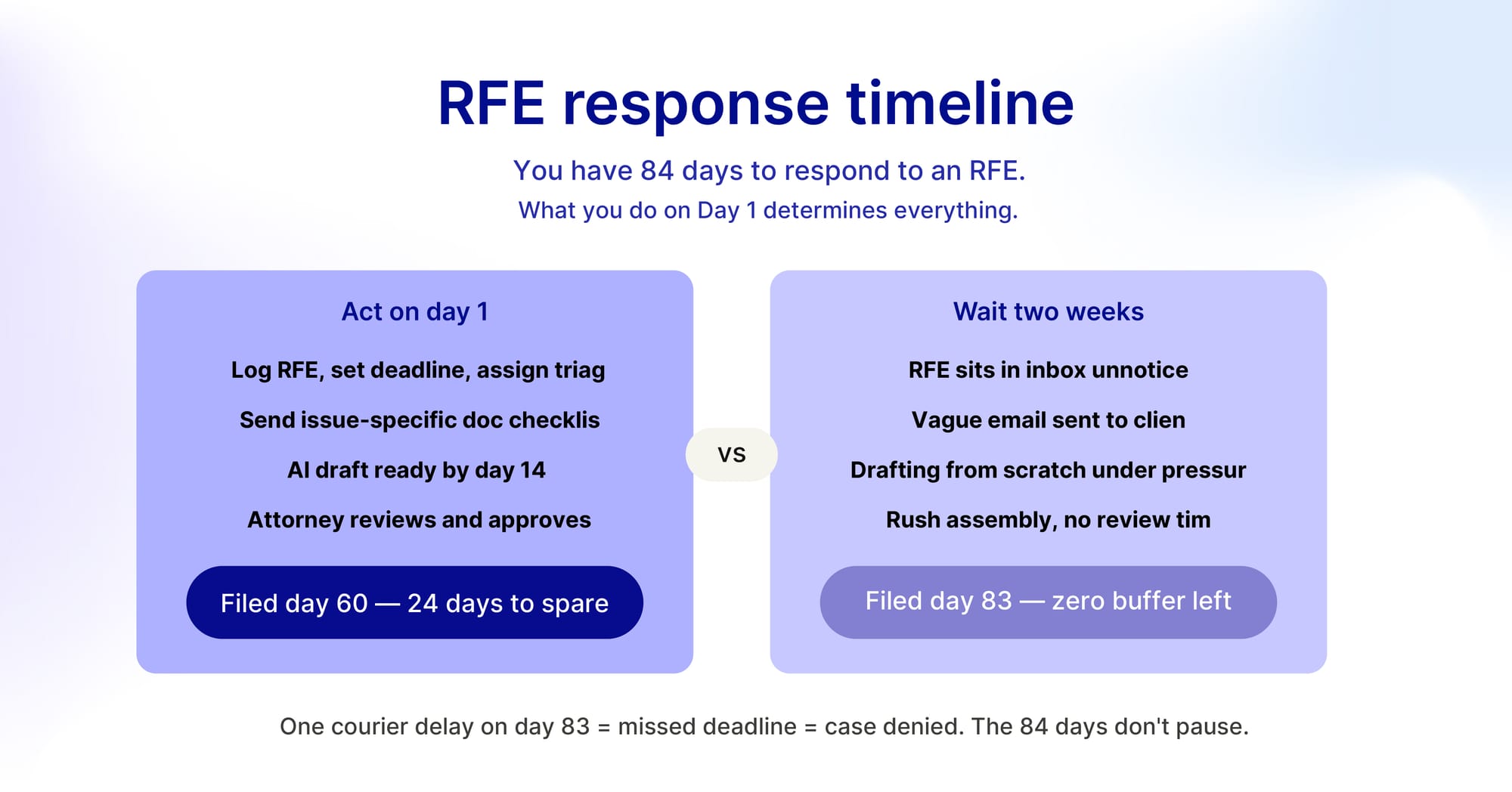
Late detection. RFEs that sit unnoticed in a mailbox or an email inbox for days before anyone starts the response process are a preventable problem that shortens the available response window unnecessarily. In a high-volume practice, physical mail handling for USCIS correspondence needs to be systematic, not informal.
Unstructured document requests. Reaching out to clients and employers for additional documentation through ad hoc emails, without a structured request that specifies exactly what is needed and by when, produces slow and incomplete responses. Clients who receive a vague request for more documents do not know what to prioritize. A structured document checklist tied to the specific RFE issues gets faster, more complete responses.
Drafting from scratch. Attorneys who approach each RFE response as a blank-page drafting exercise are spending more time than necessary on cases that share common legal arguments and structural elements. An RFE for specialty occupation on an H-1B petition raises predictable issues that warrant a predictable response structure. Having strong templates and precedent language available, and increasingly AI-assisted first drafts, recovers significant time without compromising quality.
No centralized tracking. Firms that track RFE response deadlines in individual attorney calendars or shared spreadsheets create the conditions for a deadline to be missed when someone is out, when a case changes hands, or when the volume simply exceeds what any informal system can reliably track.
Disorganized response packages. A response package that is hard for the adjudicator to navigate is a response package that is less likely to succeed. Consistent formatting, clear tabbing, and a well-organized cover letter that maps the response directly to the RFE issues are not just professional standards. They are strategic choices that affect outcomes.
What Efficient RFE Management Looks Like
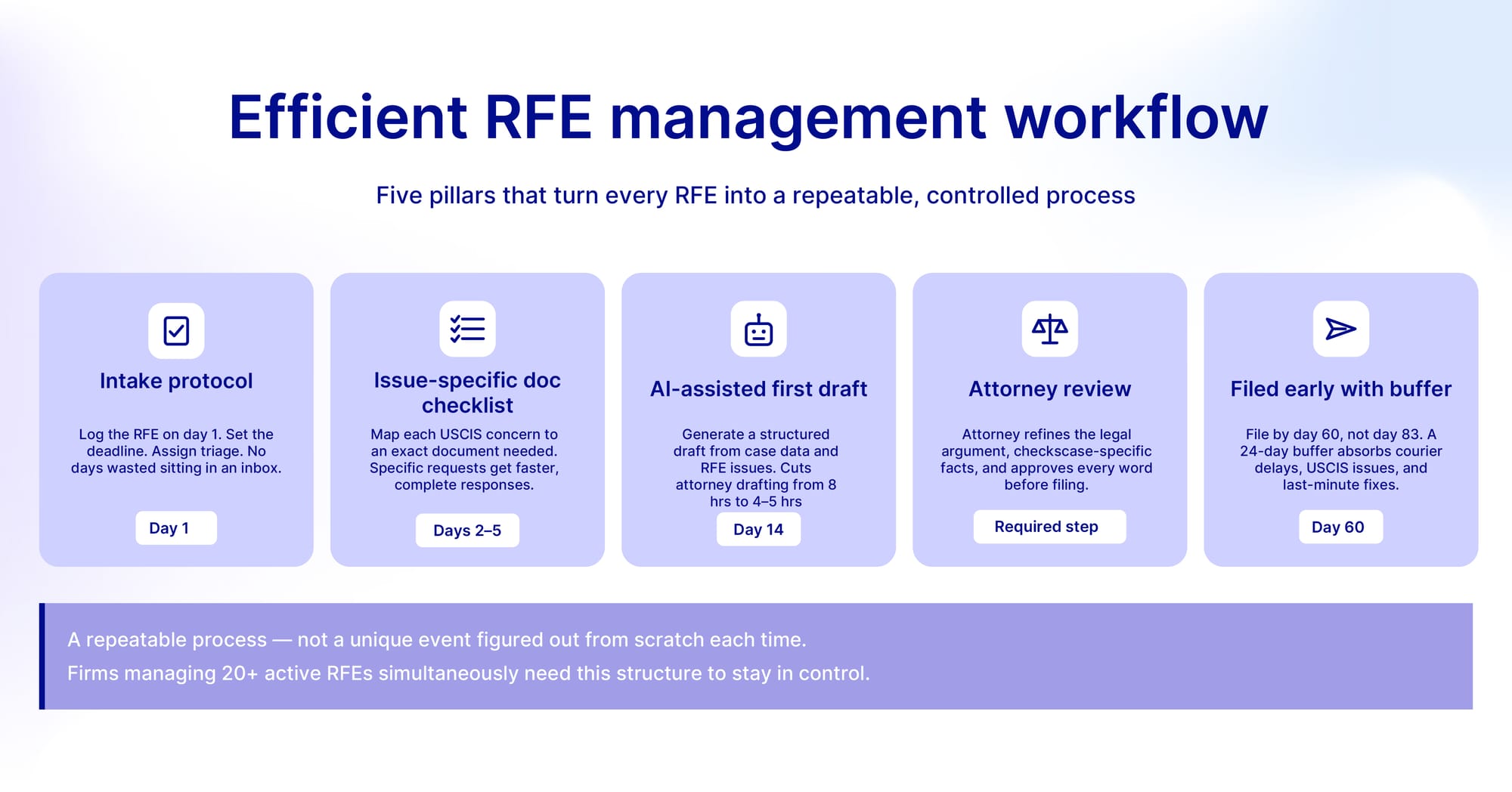
The immigration firms managing RFE volume most effectively have built a repeatable process rather than treating each RFE as a unique event to be figured out from scratch.
A Defined Intake Protocol for Every RFE
When an RFE arrives, a defined protocol kicks in immediately. The RFE is logged to the case record, the response deadline is calculated and entered into the tracking system with internal milestone alerts, initial triage is assigned to a specific person with a specific timeline, and the attorney is notified with the key issues flagged.
This sounds simple. But in firms where RFE handling is informal, the delay between an RFE arriving and active work beginning can be days. In a case with an 84-day response window, those days matter.
Issue-Specific Document Checklists
Rather than sending a generic request for more documents, structured RFE management maps the specific USCIS issues to a specific document checklist and sends that checklist to the client and employer with clear instructions and a firm internal deadline.
This improves response quality because clients know exactly what is being asked for. It also improves response speed because a specific request with a deadline produces faster action than a vague request without one.
AI-Assisted Drafting With Attorney Review
This is where technology is creating the most meaningful efficiency gains in RFE response work right now. AI drafting tools that can generate a first draft of an RFE response from the case record, the RFE issues, and the available supporting documentation are cutting the attorney time required per response significantly.
The first draft is not the final product. It requires careful attorney review, refinement of the legal argument, and incorporation of case-specific facts that the AI may not have fully weighted. But the time saved in getting from a blank page to a solid working draft is real and measurable. Attorneys who previously spent eight hours on a complex RFE response are spending four to five hours with AI assistance, with no reduction in response quality.
Toorey's AI drafting tools work exactly this way for RFE responses. The AI generates a structured first draft based on case data and the specific issues raised in the RFE. The attorney reviews, refines, and approves. Every final decision stays with the attorney. The time savings accumulate across every RFE the firm handles.
Centralized Deadline Tracking Across All Active RFEs
At any point, the supervising attorney or firm administrator should be able to see every active RFE, its response deadline, its current status, and who is responsible for each open action, in a single view.
When this visibility exists, nothing gets lost. When an RFE is tracked only in individual attorney calendars, the firm's aggregate RFE status is invisible to anyone except the individual attorneys managing each case. At high volume, that invisibility is a risk.
Structured Package Assembly and Quality Review
Every RFE response package should go through the same assembly checklist before it leaves the office: response letter reviewed and approved, all cited documents included and correctly tabbed, package organized in the sequence the cover letter describes, filing method confirmed. This checklist is not bureaucratic overhead. It is the last line of defense against the kind of filing error that undermines a strong legal argument.
The Volume Reality in 2026
Immigration attorneys who have been practicing for more than a decade will tell you that the current RFE environment is unlike anything they have seen in a long time. The rate of RFE issuance, the specificity of the issues raised, and the scrutiny applied to response packages have all increased under the current administration.
This is not a temporary spike that will resolve itself. The operational infrastructure needed to manage RFE volume efficiently is infrastructure that firms need now, not after the next wave of approvals suggests the environment has softened.
The firms that are building structured RFE response systems in 2026, with defined protocols, AI-assisted drafting, centralized deadline tracking, and consistent package assembly, are the firms that will be best positioned to handle the volume and protect their clients' cases.
The firms that are still managing RFEs informally are carrying a risk they may not fully see yet.
Toorey's AI-powered drafting tools and integrated case management help immigration firms handle RFE volume faster and with fewer errors. See how at toorey.com.