How Immigration Firms Are Managing I-9 Compliance in 2026
I-9 compliance has never been a glamorous part of immigration practice. For years it sat in the background: a documentation requirement that most employers understood in theory, managed imperfectly in practice, and rarely worried about unless something went wrong.
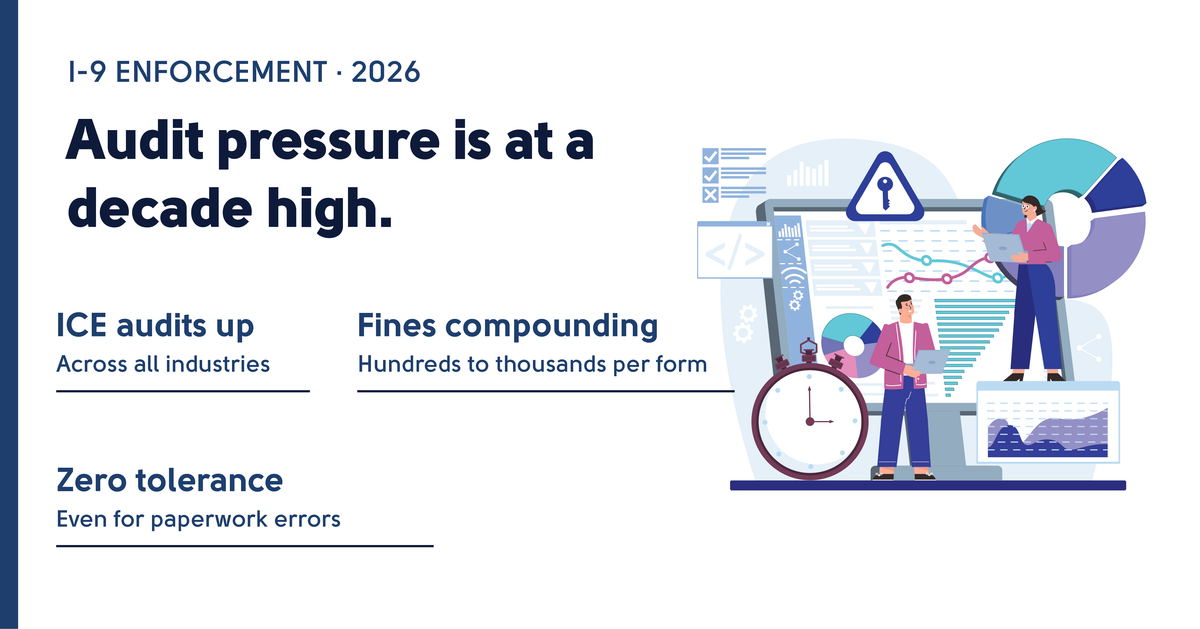
That has changed in 2026. ICE worksite enforcement is at levels not seen in over a decade. Audit notices are landing at companies of all sizes, across all industries. Fines for paperwork violations that were once treated as technicalities are now being assessed at the high end of the penalty range. And employers who previously relied on informal I-9 processes are discovering, often at the worst possible moment, that informal is not the same as compliant.
For immigration law firms, this shift has created a significant practice opportunity and a significant operational challenge at the same time. Clients need more guidance on I-9 compliance than ever before. Firms that can deliver that guidance efficiently, at scale, and with the documentation to back it up are well positioned. Firms running I-9 work through disconnected systems and manual processes are finding the volume and complexity increasingly hard to manage.
This piece covers what the current I-9 enforcement environment actually looks like, where firms and their clients are most exposed, and how the best-run immigration practices are managing compliance work in this environment.
What Has Changed in 2026
The escalation in I-9 enforcement in 2026 is not a single policy shift. It is the cumulative effect of several changes happening simultaneously.
ICE has significantly expanded its Form I-9 audit program, issuing Notices of Inspection to employers across sectors with far less warning than was typical in prior years. The hospitality, construction, agriculture, and healthcare industries have seen the highest concentration of audits, but no sector has been insulated.
Penalty amounts have increased. Current fines for substantive I-9 violations range from several hundred to several thousand dollars per violation, and for high-volume employers, those figures compound quickly across a large workforce. Employers found to have knowingly employed unauthorized workers face penalties at a different and substantially higher scale.
The enforcement posture has also shifted. Auditors are applying less discretion to technical violations than in prior cycles. Paperwork errors that might previously have been treated as correctable with a warning are now more consistently resulting in assessed fines. Employers who assumed their I-9 processes were good enough are finding out they were not.
For immigration attorneys, this means client demand for I-9 guidance, audit preparation, and internal audit services has increased sharply. It also means the stakes attached to that work are higher than they used to be.
Where Firms and Their Clients Are Most Exposed
I-9 violations fall into two broad categories: substantive violations and technical violations. Understanding the distinction matters for how firms advise clients and how they prioritize compliance work.
Substantive violations involve the core purpose of the I-9 form: verifying that an employee is authorized to work in the United States. Failing to complete Section 2, accepting documents that do not establish identity and work authorization, or failing to reverify when work authorization expires are all substantive violations. These carry higher penalties and, in cases involving knowing employment of unauthorized workers, potentially criminal exposure.
Technical violations are paperwork errors: missing dates, incomplete sections, incorrect document list entries, or failure to update forms when USCIS releases new versions. These carry lower penalties per violation but compound significantly at scale. An employer with 500 employees and a 15 percent technical error rate has 75 violations before they have done anything intentionally wrong.
The exposure areas that come up most consistently in 2026 audits:
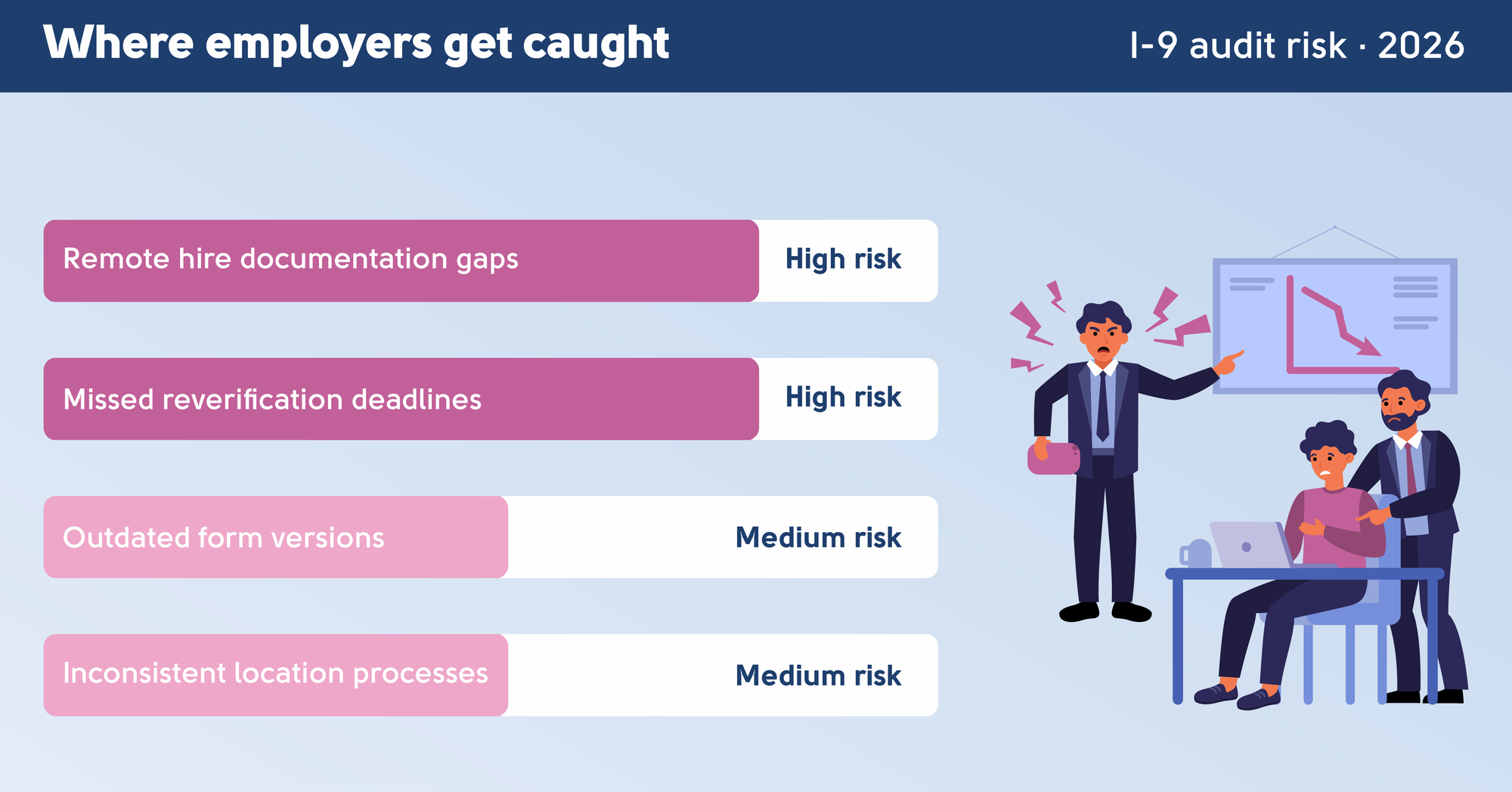
Remote and hybrid workforce documentation. The pandemic-era remote I-9 flexibility has ended, and many employers who onboarded remote workers during that period are discovering their documentation does not meet current in-person verification standards. The backlog of remote hires needing physical reverification is a significant liability for employers who have not addressed it.
Reverification failures. Employees on temporary work authorization require reverification before their authorization expires. Employers managing this manually, through spreadsheets or calendar reminders, routinely miss reverification deadlines as workforce size grows. Each missed reverification is a potential violation.
Form version errors. USCIS periodically releases updated versions of Form I-9 and requires employers to use the current version for new hires. Employers continuing to use outdated versions after the required transition date are in violation for every form completed on the old version.
Inconsistent processes. Employers with multiple locations or high-volume hiring often have I-9 processes that vary by location or by the individual HR staff member conducting the verification. Inconsistency in itself creates audit risk because it makes it harder to demonstrate a good-faith compliance program.
What Good I-9 Compliance Support Looks Like From a Firm
Immigration firms that provide I-9 services to employer clients are doing several things well that firms still building this practice can learn from.
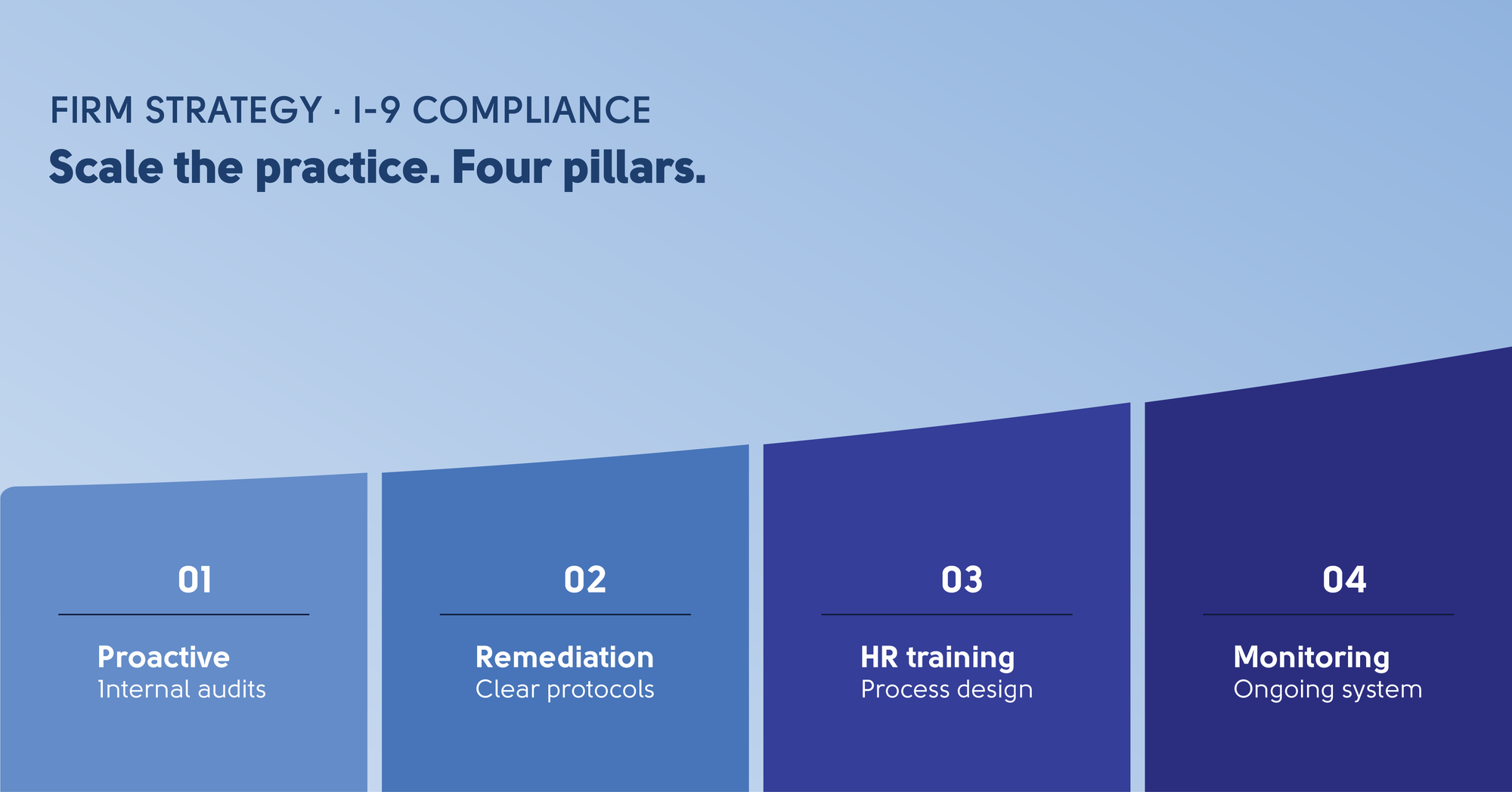
Proactive internal audit services. Rather than waiting for clients to call after receiving an NOI, leading firms are offering proactive I-9 internal audits as a standing service. A systematic review of a client's I-9 inventory, identifying and correcting errors before an ICE audit does, is one of the highest-value services an immigration firm can provide in the current environment. It is also highly repeatable: clients who have gone through one internal audit typically want to maintain an ongoing audit cadence.
Clear remediation guidance. When errors are found, firms need to guide clients through the correction process accurately. Not all I-9 errors can be corrected retroactively, and correcting some errors incorrectly can make things worse. Having clear, documented remediation protocols for different error types is essential for firms doing this work at volume.
Training and process design. Many I-9 violations are not the result of bad intent. They are the result of HR staff who were not adequately trained, or processes that were not designed with compliance in mind. Immigration firms that offer I-9 training programs and help clients design compliant verification processes are providing durable value that extends beyond any individual audit.
Ongoing monitoring. Compliance is not a one-time project. Work authorization expiration dates need to be tracked. Form I-9 updates need to be incorporated. New hire processes need to stay current with USCIS requirements. Firms that build ongoing monitoring relationships with employer clients create recurring revenue and deep client loyalty.
The Operational Challenge: Managing I-9 Work at Scale
Here is where many immigration firms run into difficulty. The analytical and advisory work of I-9 compliance is well within the expertise of a trained immigration attorney or paralegal. The operational challenge is managing that work systematically across multiple clients, each with potentially hundreds or thousands of employees and ongoing documentation needs.
Manual I-9 audit processes are slow, inconsistent, and hard to scale. Reviewing paper I-9 forms or disorganized digital files one by one, flagging errors in a spreadsheet, and tracking remediation status through email is the way most firms still do this work. It is also the way errors get missed, timelines slip, and the quality of the work product varies from engagement to engagement.
The firms managing I-9 compliance most efficiently are using platforms that give them structured workflows for audit review, clear documentation of findings and remediation steps, and visibility across all active client engagements from a single dashboard. When a client has 400 I-9 forms to review, the difference between a structured system and a manual process is the difference between a manageable engagement and an overwhelming one.
Toorey's case management infrastructure supports exactly this kind of structured compliance work. Every client engagement has a central record where documents, findings, tasks, and deadlines live together. Paralegals working within the platform can move through a review systematically, with clear assignment of ownership and a complete audit trail of every step taken. Attorneys have real-time visibility into the status of every engagement without having to ask anyone for a status update.
For firms building or expanding an I-9 compliance practice in 2026, the operational infrastructure is not a secondary consideration. It is what determines whether the practice scales or stalls.
What Employer Clients Should Be Doing Right Now
For immigration attorneys advising employer clients on I-9 compliance in the current environment, the practical guidance is consistent across firm sizes and industries.
Conduct a self-audit before ICE does. A voluntary internal review of existing I-9 documentation, with remediation of correctable errors, puts the employer in a substantially better position than discovering the same errors under an NOI. Demonstrating a good-faith compliance program is a meaningful factor in how enforcement actions are resolved.
Establish a reverification tracking system. Every employee on temporary work authorization should have a tracked expiration date with advance notice built in. This is not a complex system to implement, but it requires discipline to maintain. Manual tracking across a growing workforce breaks down. A structured system with automated alerts does not.
Train HR staff on current requirements. I-9 requirements have changed several times in recent years. HR staff trained two or three years ago may be following outdated procedures. Current training, documented and repeatable, is both a compliance measure and evidence of good faith.
Review remote hire documentation from 2020 to 2023. Employers who took advantage of pandemic-era remote verification flexibility should have a clear picture of which employees were onboarded remotely and whether their documentation meets current standards.
The Bottom Line for Immigration Firms
I-9 compliance has moved from a background practice area to a front-burner client priority in 2026. The firms that recognize this shift and build the capacity to serve it well, with clear advisory services, scalable operational processes, and the right technology infrastructure, are positioned to deepen existing client relationships and attract new ones.
The firms that continue treating I-9 work as occasional and ad hoc are leaving both revenue and client value on the table at a moment when demand has never been higher.
Toorey gives immigration firms the case management infrastructure to run I-9 compliance work at scale, with full visibility, structured workflows, and managed paralegal support. See how at toorey.com.