How AI Is Changing Immigration Law: What Attorneys Need to Know in 2025
Artificial intelligence has arrived in immigration law, and the conversation has moved well past theory. Attorneys who dismissed AI tools two years ago are now using them daily. Firms that adopted early are handling more cases with smaller teams. And the gap between AI-enabled practices and those still running on spreadsheets and email is widening fast.
But AI in legal practice is also genuinely misunderstood. There's hype on both sides: vendors overselling what the technology can do, and skeptics dismissing tools that are already delivering real value. This piece cuts through both.
Here's what AI is actually doing in immigration law right now, where it falls short, and how forward-thinking firms are using it well.
What AI Can Do in an Immigration Practice Today
Draft Routine Documents in Minutes
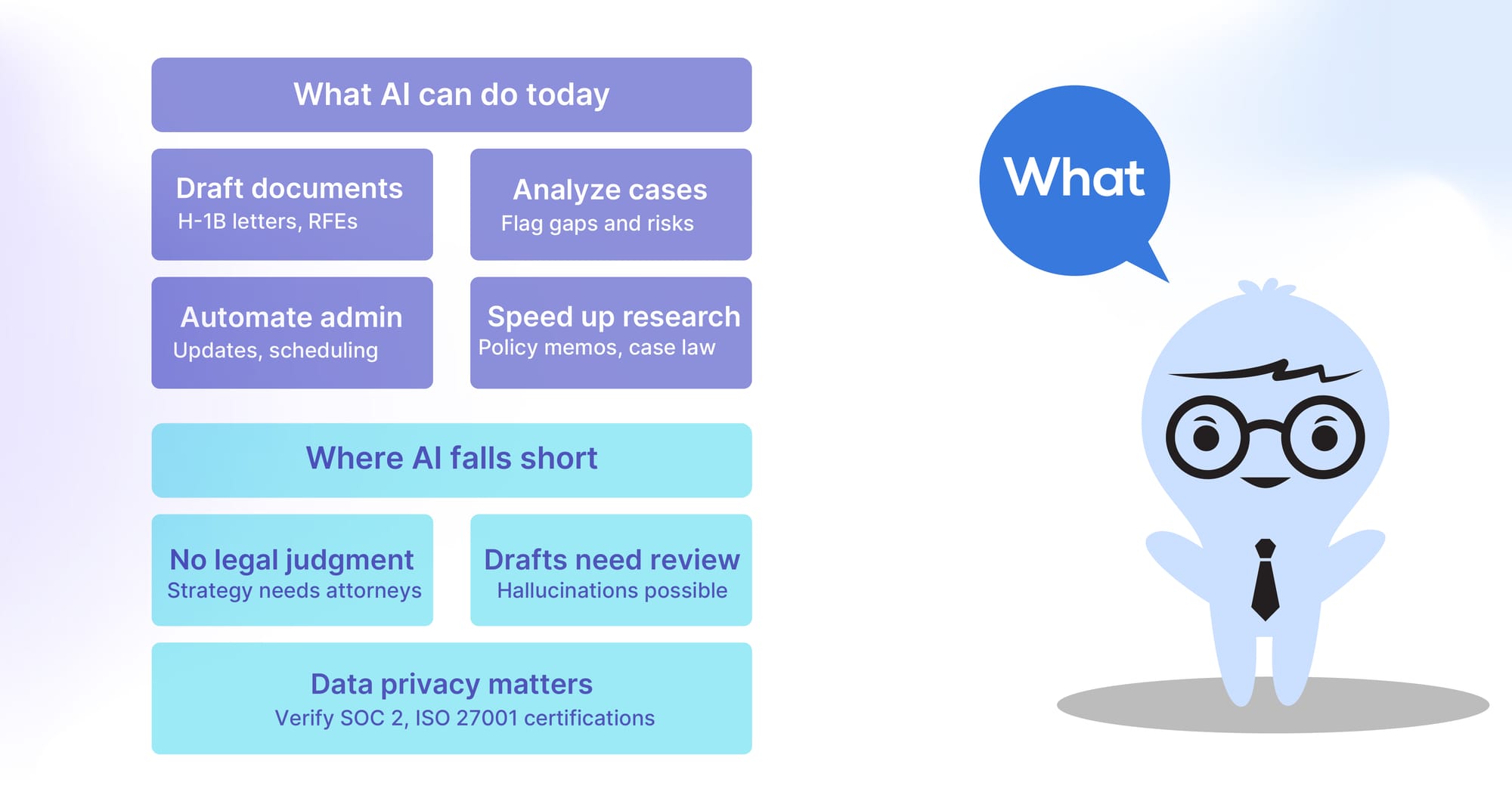
The most immediately useful application of AI in immigration law is document drafting. H-1B support letters, cover letters, RFE responses, employer petitions, and other standard documents follow predictable structures. They require accuracy, consistency, and professional language, but the underlying logic of most first drafts is largely formulaic.
AI drafting tools can generate a complete, well-structured first draft from case data in minutes. For an attorney who previously spent 45 minutes writing a support letter from scratch, or a paralegal who spent an afternoon assembling an RFE response, that's a significant shift in how time gets allocated.
The important caveat: AI-generated drafts are a starting point, not a finished product. Every document still requires attorney review, refinement, and sign-off. But the time saved in getting from a blank page to a solid working draft is real and measurable.
Analyze Case Strengths and Flag Risks
Beyond drafting, AI can analyze a case's underlying data and surface potential issues before they become problems. Which supporting documents are missing? Where does the employer's description of the role not align with the visa category requirements? Is there anything in the beneficiary's history that warrants closer attention?
This kind of proactive case analysis is difficult to do consistently at scale without technology. When a firm is managing hundreds of active cases, the chance of a critical gap slipping through human review increases simply as a function of volume. AI tools that flag these issues systematically give attorneys a meaningful safety net.
Toorey's AI layer does exactly this: analyzing case data to surface strengths, identify gaps, and generate actionable recommendations, while keeping the attorney in full control of every final judgment.
Automate Repetitive Administrative Tasks
A substantial portion of the work in immigration law is not legal work. It's coordination: following up with clients for missing documents, sending status updates, routing USCIS notices to the right case files, scheduling internal deadlines.
AI-assisted automation can handle much of this without attorney involvement. Clients receive automatic status updates when milestones are reached. Document requests go out on a schedule. Notices are matched to cases automatically. The result is that attorneys and paralegals spend more of their time on work that actually requires their expertise.
Accelerate Research and Precedent Review
Policy changes in U.S. immigration law come fast. Between executive actions, USCIS policy updates, and regulatory shifts, staying current is a full-time job on its own. AI-assisted research tools can scan large volumes of guidance, policy memos, and case law to surface the most relevant updates and precedents for a specific case type, faster than manual research allows.
Where AI Falls Short
Being clear about the limits of AI in immigration law is as important as understanding its capabilities.
AI cannot exercise legal judgment. Determining the right visa strategy for a complex case, advising a client on the risks of a particular filing approach, or crafting the legal argument for a difficult RFE response requires a licensed attorney's knowledge, experience, and professional responsibility. AI is a tool that informs that judgment, not a substitute for it.
AI-generated drafts require careful review. A first draft produced by AI may be grammatically correct and structurally sound but contain factual inaccuracies, misapplied legal standards, or case-specific details that the model hallucinated. Attorneys who treat AI output as final without careful review are taking a real risk with their clients and their license.
Data privacy requires careful vendor evaluation. The case data fed into AI tools is highly sensitive. Before using any AI-powered feature in your practice, understand exactly how your vendor handles that data: where it is stored, whether it is used to train models, how it is protected and what your obligations are under any applicable data protection regulations.
This is why security certifications, SOC 2 Type II and ISO 27001 among them, matter when evaluating AI-enabled immigration platforms. The technology is only as trustworthy as the infrastructure it runs on.
The "AI Drafts, Attorney Approves" Model
The firms using AI most effectively in immigration practice have settled on a clear operating model: AI handles the time-consuming first pass, and the attorney maintains full control over every decision and every final document.
This is not a compromise. It is actually the strongest possible use of both the technology and the attorney's expertise. AI is excellent at the parts of legal work that are systematic, pattern-based, and repetitive. Attorneys are excellent at judgment, strategy, and accountability. The "AI drafts, attorney approves" model allocates each to what it does best.
Under this model, a single attorney can comfortably manage the output that previously required a larger team. Not because AI is replacing the legal work, but because it is eliminating the administrative overhead that surrounded it.
Toorey is built around this model. AI handles drafting, case analysis, and risk flagging. Every recommendation is surfaced to the attorney, who reviews, refines, and makes the final call. There is no automation without attorney oversight. That is by design.
What This Means for Staffing and Firm Structure
AI adoption in immigration law is already beginning to shift how firms think about staffing, not by eliminating paralegal roles, but by changing what those roles look like.
Paralegals who spend most of their time on document assembly, data entry, and status tracking will see those tasks increasingly automated. The paralegal work that remains, and that becomes more valuable, is the work that requires judgment, client communication, and case-specific coordination.
For firm leaders, this creates an opportunity to restructure support staff roles around higher-value activities while using AI and managed paralegal platforms to absorb the volume-driven administrative work that previously required more headcount.
It also raises the ceiling on how many cases a firm can handle. An attorney using AI-assisted drafting and automated workflows is not managing twice the caseload by working twice as hard. They are managing more cases because the non-legal overhead per case has dropped substantially.
The Regulatory Landscape: What Attorneys Should Watch
AI use in legal practice is attracting increasing attention from bar associations and state regulators. The American Bar Association and several state bars have issued guidance on AI use, and more is coming.
The core themes in current guidance are consistent: attorneys must maintain competence with the technology they use, must supervise AI output before it is submitted or sent, and remain professionally responsible for all work product regardless of how it was generated. Ignorance of what an AI tool produced on your behalf is not a defense.
This makes the choice of AI platform a professional responsibility issue, not just an operational one. Understanding how your immigration software's AI features work, what they generate, and how they handle client data is part of the duty of competence that comes with using these tools.
Questions to Ask Before Adopting AI Tools in Your Immigration Practice
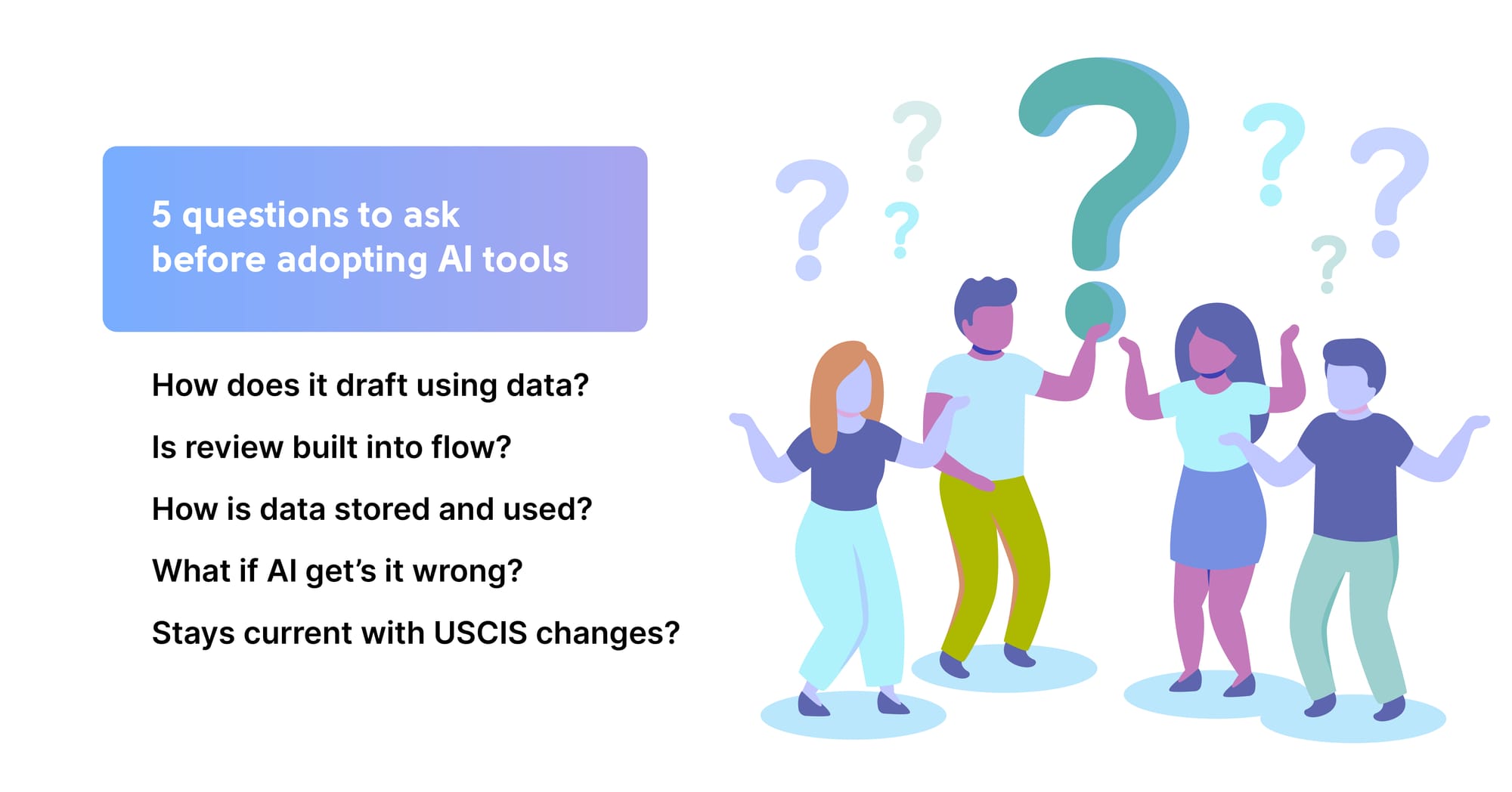
If you're evaluating AI-powered immigration software, these are the questions that matter:
How does the AI drafting feature work, and what data does it use? Specifically: is it pulling from your case file, or generating generic output that you then have to customize? The former is far more useful.
Is there a clear attorney review step built into the workflow? Responsible platforms build this in by design rather than leaving it to the attorney to remember.
How is my client data handled? Is it stored securely? Is it used to train models? What certifications does the vendor hold?
What happens when the AI gets something wrong? How does the platform handle errors, and what support does the vendor provide?
How does the platform stay current with USCIS policy changes? AI tools are only as useful as the information they are built on. A model trained on outdated policy guidance is worse than no model at all.
Conclusion: The Question Is Not Whether, But How
The question for immigration attorneys in 2025 is no longer whether to use AI. It is how to use it well: with appropriate oversight, with clear professional responsibility practices, and with a platform built to make the attorney more capable rather than less accountable.
Firms that get this right are gaining a durable competitive advantage: more cases, faster turnaround, fewer errors, and attorneys freed to focus on the judgment-intensive work that actually requires them.
Platforms like Toorey are making this accessible to immigration firms of all sizes, with AI-powered drafting and case analysis built into the same system that handles case management, billing, compliance, and paralegal operations.
The technology is here. The question is whether your practice is set up to use it.
See how Toorey's AI tools work in practice. Book a demo at toorey.com.