How to Manage H-1B Cases More Efficiently: A Firm's Guide

H-1B season is the most concentrated operational stress test an immigration firm faces all year. In the space of a few weeks, firms that handle employment-based immigration go from managing a steady caseload to processing dozens or hundreds of petitions simultaneously, each with hard deadlines, complex employer documentation requirements, and clients whose careers and U.S. status depend on getting it right.
For firms that are well-prepared, it is demanding but manageable. For firms running on spreadsheets, email threads, and individual paralegal knowledge, it is the period when errors happen, deadlines get dangerously close, staff burn out, and client relationships strain under the pressure.
The difference between those two experiences is not talent. It is systems.
This guide covers what efficient H-1B case management actually looks like in practice, where most firms lose time and introduce risk, and how the firms handling high H-1B volumes without chaos have structured their operations.
Why H-1B Cases Are Operationally Different
Not all immigration case types are equally demanding from an operational standpoint. H-1B petitions sit at the complex end of the spectrum for several reasons.
They cluster. Unlike green card cases or family-based petitions that arrive throughout the year, H-1B cap cases arrive in a concentrated window. A firm that handles 80 H-1B petitions a year may need to prepare all 80 in a six-to-eight week period. That kind of volume concentration exposes every weakness in your operations simultaneously.
They require employer coordination. H-1B petitions involve multiple parties: the beneficiary, the petitioning employer, HR contacts, sometimes outside payroll vendors. Coordinating documentation across all of those parties, with different response times and different levels of familiarity with the process, is one of the primary sources of delay and error.
They involve layered deadlines. The USCIS filing window is the hard external deadline, but there are multiple internal milestones before it: LCA certification, support letter drafting, employer documentation assembly, beneficiary questionnaire completion, and packet review. Each of these has to happen in sequence, and a delay in any one of them compresses the time available for everything that follows.
They carry high stakes for beneficiaries. An H-1B cap miss is not a setback. It is a full-year wait before the next cap opening. For a beneficiary whose status depends on the petition, the consequences of a firm error are severe and lasting. That stakes level creates pressure that compounds the operational demands.
Where Most Firms Lose Time and Introduce Risk
Before covering what efficient looks like, it helps to be specific about where inefficiency actually lives in H-1B case management.
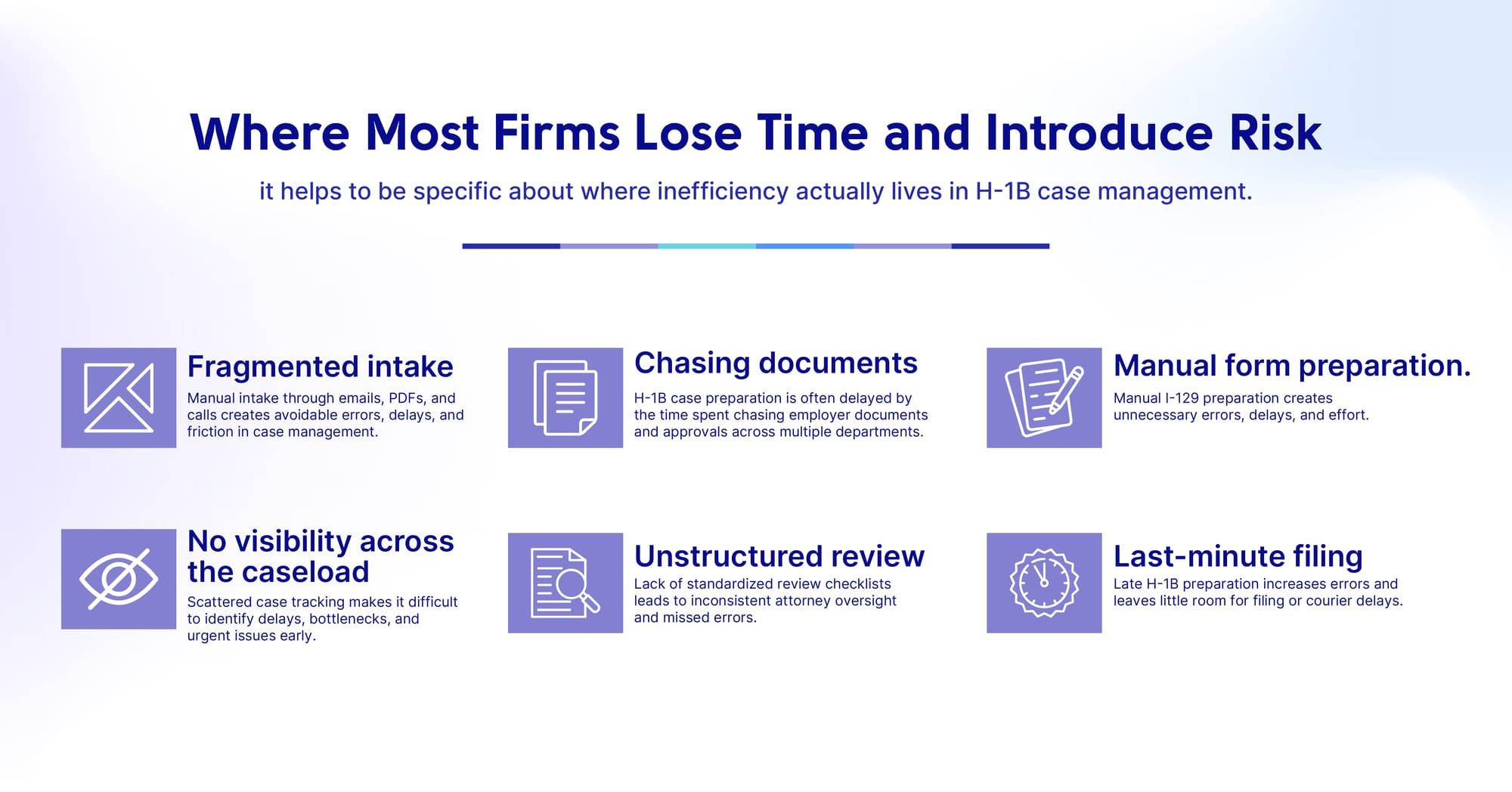
Fragmented intake. Many firms still collect employer and beneficiary information through email, PDF questionnaires, or phone calls that get transcribed manually. Every manual data touch is an opportunity for error and a source of delay. If intake is not structured and centralized, you are starting each case with unnecessary friction.
Chasing documents. Employer documentation for H-1B petitions is notoriously difficult to collect. Support letters require sign-off from people who do not understand why they matter. Financial records need to come from departments that have no immigration context. The firms that spend the most time during H-1B season are often spending it chasing documents rather than preparing petitions.
Manual form preparation. I-129 preparation done manually from scratch is time-consuming and error-prone. Firms that have not implemented form auto-population from case data are introducing unnecessary effort and risk at every petition.
No visibility across the caseload. When case status lives in individual paralegal spreadsheets or inboxes, attorneys cannot see at a glance which cases are on track, which are delayed, and where the bottlenecks are. Problems that could be addressed early go unnoticed until they become urgent.
Unstructured review. Attorney review of completed petitions without a standardized checklist is another source of inconsistency. Different attorneys catch different things. Things that should always be caught sometimes are not.
Last-minute filing. Firms that do not start H-1B preparation early enough routinely find themselves assembling and shipping packets under time pressure that increases error risk and leaves no buffer for USCIS or courier issues.
What Efficient H-1B Case Management Looks Like
Start Earlier Than You Think You Need To
The firms that manage H-1B season most smoothly start earlier than their competitors. Not marginally earlier. Significantly earlier.
Employer outreach for cap cases should begin in January at the latest. That means sending intake questionnaires, initiating LCA processes, and beginning support letter drafts before most firms have started thinking about H-1B season at all. The firms that wait until March to begin engagement are the ones scrambling in late March.
Early starts do two things: they give more time to chase the slow-responding employers and they give the legal team more time to identify and address case-specific complications before the filing window.
Standardize and Automate Intake
Structured intake is one of the highest-leverage improvements an immigration firm can make to its H-1B workflow. Replace email-based document collection with a structured client portal where employers and beneficiaries complete questionnaires directly into the system, upload documents in the right categories, and receive automatic reminders when something is missing or incomplete.
When intake data flows directly into the case record, form preparation becomes faster and more accurate. When reminders go out automatically rather than manually, the document-chasing problem shrinks significantly.
Toorey's structured intake workflows do exactly this: questionnaires, document uploads, and follow-up reminders all managed within the platform so paralegals spend their time on case preparation rather than coordination overhead.
Build Case Templates for Each H-1B Scenario
Not all H-1B petitions are the same. A cap-subject new petition for a software engineer looks different from an H-1B extension with an approved I-140. An H-1B transfer has a different document checklist from an amendment. Treating all H-1B cases as variations of the same template introduces both inefficiency and error risk.
Build out specific case templates for each scenario your firm regularly handles, with the correct document checklists, task sequences, and review steps for each type. When a new case comes in, the template deploys and the team works through a defined process rather than reconstructing the workflow from scratch each time.
Implement Active Deadline Management
For H-1B season, passive deadline tracking is not enough. You need active deadline management: a system that surfaces the status of every case against its milestones in real time, flags cases that are behind, and escalates issues before they become critical.
At any point during filing season, you should be able to answer these questions without asking anyone: How many cases are ready to file? How many are waiting on employer documentation? How many have LCA issues? How many have not had intake completed? If those answers require a team meeting or a round of emails to assemble, your visibility is insufficient for the volume you are managing.
Standardize Attorney Review
Every H-1B petition that goes out the door should go through the same review checklist regardless of which attorney or paralegal prepared it. That checklist should cover the legal standards specific to the visa category, the completeness of the supporting documentation, the accuracy of form entries, and the consistency between the support letter and the I-129.
Standardized review does not slow things down. It actually speeds up the overall process because it reduces the back-and-forth that comes from catching issues at different stages for different cases.
Ship Early
Build your internal filing deadline at least a week before the actual USCIS deadline. That buffer exists for a reason: courier delays, last-minute document issues, USCIS receipt problems. Firms that plan to file on the last day of the window are planning to file without any margin.
For premium processing cases, confirm premium processing receipt and account for the additional fee in your client intake process from the start rather than as a last-minute add-on.
The Role of Technology in H-1B Efficiency
Technology does not replace good process. But good process implemented in the right technology scales in a way that good process alone does not.
The firms managing the highest H-1B volumes most efficiently are using platforms that combine several capabilities in one environment: structured intake, form auto-population, active deadline tracking, task management with clear ownership, attorney review checklists, and integrated billing.
When all of that lives in one system, the coordination overhead that consumes so much attorney and paralegal time during H-1B season drops significantly. Cases move because the system is designed to move them, not because someone is manually orchestrating every step.
Toorey is built for exactly this kind of high-volume immigration practice. The platform manages H-1B cases from intake to filing, with automated workflows, real-time visibility across the entire caseload, and managed paralegal support for firms that need to scale execution capacity during peak season without adding permanent headcount.
Building for the Season Before the Season
The most important thing to understand about H-1B efficiency is that the work happens before filing season opens, not during it.
Firms that invest in structured workflows, standardized templates, and the right technology in the months before the cap window are the ones that move through filing season with confidence.
Firms that wait until the pressure is on to figure out their process are the ones that find themselves managing chaos instead of cases.
H-1B season is predictable. It comes every year, on roughly the same schedule, with roughly the same requirements. The firms that treat it as a known operational challenge to be prepared for, rather than a recurring emergency to be survived, are the ones that grow their H-1B practice sustainably.
Toorey helps immigration firms manage H-1B season with structured workflows, real-time case visibility, and managed paralegal support. See how at toorey.com.