How Immigration Policy Uncertainty Is Changing How Law Firms Operate in 2026
Immigration law has always involved uncertainty. Policy changes, regulatory shifts, and administrative priorities have always required attorneys to stay current and adapt their practice. That has always been part of the job.
What is different in 2026 is the speed and the breadth of change happening simultaneously. In the past eighteen months, immigration practitioners have navigated significant shifts in H-1B adjudication standards, escalating RFE rates, TPS termination litigation that has changed work authorization status for thousands of employees, enhanced I-9 enforcement, new USCIS security vetting processes affecting adjudication timelines, and an enforcement environment that has fundamentally changed how employer clients think about immigration risk.
Each of these changes on its own would require firms to adjust. Together, they are forcing a rethink of how immigration practices operate at a more fundamental level. The firms navigating this environment most effectively are not necessarily the ones with the deepest legal knowledge. They are the ones that have built operational structures capable of absorbing change without breaking.
The Specific Changes Reshaping Practice in 2026
To understand what good operations look like in the current environment, it helps to be specific about what firms are actually dealing with.
H-1B scrutiny and RFE rates. Specialty occupation determinations have tightened significantly. USCIS adjudicators are applying more scrutiny to the relationship between the petitioned role and the required degree, and issuing RFEs at rates that are materially higher than they were two to three years ago. For firms with large employment-based caseloads, the proportion of H-1B petitions generating RFEs has increased substantially. This has shifted more attorney time toward response work and changed the economics of H-1B representation.
TPS litigation and work authorization volatility. Temporary Protected Status for multiple country designations has been the subject of ongoing litigation, with court orders restoring and terminating protections in ways that have made compliance guidance difficult to keep current. Employer clients managing TPS employees have needed real-time guidance on reverification requirements, I-9 updates, and what the current status of work authorization is for different national groups. Firms advising in this area have had to update their guidance multiple times in short succession.
Enhanced USCIS background check procedures. USCIS announced new enhanced FBI security vetting procedures effective April 2026, creating an adjudication pause for cases requiring fingerprint-based background checks. The impact on processing timelines has been significant for affected case types, and clients with time-sensitive situations have needed active management and communication as cases that were expected to resolve have been held.
ICE enforcement escalation. Worksite enforcement actions, I-9 audits, and the broader enforcement posture have all intensified. Employer clients who previously treated immigration compliance as a background function are now actively asking their legal teams for guidance on audit preparedness, internal compliance programs, and what to do if ICE arrives at their facility. This has created new demand for compliance advisory work that many immigration firms were not previously resourced to handle.
Visa Bulletin movement and green card timeline uncertainty. Priority date movement in employment-based green card categories has been unpredictable, with periods of significant forward movement followed by retrogression. Clients planning around anticipated adjustment of status windows have had those plans disrupted, requiring active communication and timeline management.
What Operational Agility Actually Means
The phrase "operational agility" gets used loosely. In the context of an immigration firm in 2026, it has a specific practical meaning: the ability to absorb a policy change, adjust the firm's workflows and client guidance accordingly, and keep active cases moving without disrupting service quality or missing deadlines.
That kind of agility is not primarily about how quickly attorneys can read a new policy memo. It is about whether the firm's operational infrastructure is structured to absorb and propagate changes systematically.
Consider what happens when USCIS releases updated guidance that changes how a specific case type should be prepared. In a firm with structured, platform-based workflows, the change can be incorporated into case templates, checklists, and preparation guides in a controlled way, and every new case of that type benefits from the update. In a firm where workflows exist in individual attorneys' heads and informal practice, the same update has to filter through to each person individually, inconsistently, and often incompletely.
The same applies to form updates, reverification requirement changes, and enforcement guidance. Firms where operational knowledge lives in systems adapt faster and more consistently than firms where it lives in people.
How the Best-Run Firms Are Responding

Building Communication Infrastructure for Fast-Moving Situations
The TPS litigation cycle in 2025 and 2026 illustrated something important about client communication in volatile policy environments. Employer clients managing TPS employees did not just need accurate legal guidance. They needed that guidance quickly, in plain language, with clear instructions about what to do and by when. Firms that had client communication infrastructure in place, whether through a client portal, structured email workflows, or both, were able to get updated guidance to affected clients efficiently. Firms relying on individual attorney emails and phone calls were slower, less consistent, and more stretched.
The lesson is not specific to TPS. Any rapid policy development creates the same demand: clients need to hear from their attorneys quickly, the message needs to be consistent, and the communication needs to be documented. Firms that have built systems for this are better positioned for the next policy disruption than firms that are figuring it out under pressure each time.
Strengthening Deadline Management in a Higher-RFE Environment
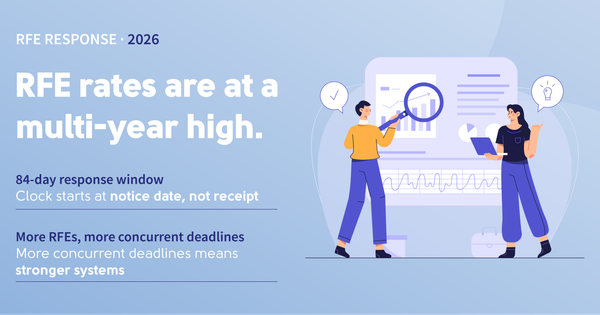
Higher RFE rates mean more active deadlines across the caseload at any given time. A firm that was managing 10 active response deadlines two years ago may now be managing 30. A deadline tracking system that was adequate at lower volume is not necessarily adequate now.
The firms that are handling RFE volume most effectively have active, system-level deadline tracking that surfaces upcoming response windows across the entire caseload, assigns ownership, and escalates as deadlines approach. They are not relying on individual attorney calendars or paralegal memory to track deadlines that can end a case if missed.
Investing in AI-Assisted Drafting for Repeatable Work
In a higher-volume RFE environment, attorney time is the binding constraint. The fastest way to expand effective attorney capacity without hiring is to reduce the time each RFE response consumes without reducing quality.
AI-assisted drafting is delivering on this in practical terms. Attorneys using AI tools to generate first drafts of RFE responses, support letters, and cover letters consistently report meaningful reductions in drafting time, with the attorney's review and refinement ensuring the final product meets their standards. Across a practice handling dozens of RFEs per month, those time savings are significant.
The critical design principle is that AI generates the draft and the attorney approves the final product. Every immigration attorney practicing in 2026 is professionally responsible for every document that goes out under their name. AI assistance does not change that responsibility. A well-designed platform makes the attorney's review step efficient and structured rather than creating pressure to skip it.
Building Compliance Capabilities Alongside Traditional Case Work
The enforcement environment in 2026 has made I-9 compliance, audit preparedness, and workplace immigration compliance significant client priorities in a way they were not two or three years ago. Firms that have built the capability to advise on and manage compliance work alongside their traditional visa and green card practices are serving clients more comprehensively and capturing revenue that would otherwise go elsewhere.
This requires operational infrastructure as much as legal expertise. Managing an I-9 audit engagement for a client with hundreds of employees requires structured document review workflows, systematic error tracking, and clear communication of findings and remediation steps. Firms with strong case management platforms can scale this work. Firms without them hit a wall at relatively low volume.
Staying Ahead of USCIS Form and Policy Updates
USCIS has updated multiple forms and released significant policy guidance at a pace that has kept immigration attorneys busy staying current. Firms that catch these updates late, because their process for monitoring USCIS releases is informal, run the risk of preparing cases on outdated standards or filing on superseded forms.
The most reliable protection against this is a combination of structured monitoring processes and a case management platform that incorporates form and policy updates systematically rather than leaving it to individual attorneys to catch and apply. When a form update is released, it should be in every active case template before the first new case using the old form is filed.
The Structural Advantage
There is a version of this environment that is simply harder. More RFEs, more compliance demands, more client communication needs, more policy monitoring. More of everything, with the same or fewer resources.
And there is a version where the operational infrastructure absorbs the additional load. Where AI handles the first draft of the RFE response. Where deadline tracking surfaces every active window automatically. Where client updates go out on a schedule rather than when someone remembers. Where form updates are incorporated into workflows before the first affected case is filed.
The difference between those two versions of 2026 is not legal talent. It is systems.
Toorey is built for the second version. An all-in-one immigration practice management platform combining AI-powered drafting, active deadline management, managed paralegal support, client communication tools, and enterprise-grade compliance infrastructure, designed specifically for U.S. immigration firms navigating exactly the environment that 2026 has delivered.
The firms that have built their operations on this kind of foundation are not just surviving the current environment. They are growing through it.
See how Toorey helps immigration firms stay operationally agile in a fast-moving policy environment. Book a demo at toorey.com.